 BornAgain
≻ git-develop
≻ Documentation ≻ Reference ≻ Sample model ≻ Particles ≻ Form factor ≻ Hard particles ≻ Pyramid3
BornAgain
≻ git-develop
≻ Documentation ≻ Reference ≻ Sample model ≻ Particles ≻ Form factor ≻ Hard particles ≻ Pyramid3
BornAgain
≻ git-develop
≻ Documentation ≻ Reference ≻ Sample model ≻ Particles ≻ Form factor ≻ Hard particles ≻ Pyramid3
BornAgain
≻ git-develop
≻ Documentation ≻ Reference ≻ Sample model ≻ Particles ≻ Form factor ≻ Hard particles ≻ Pyramid3
A truncated pyramid (frustum) with trigonal base.
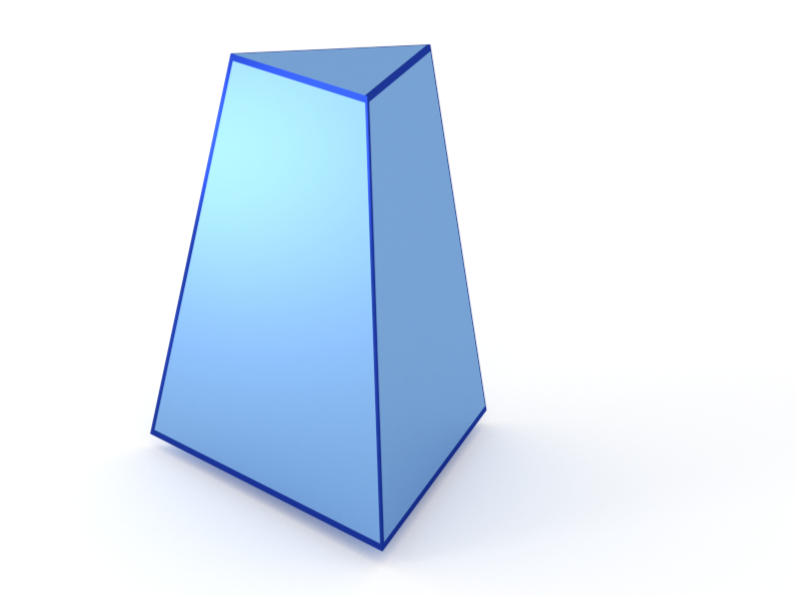
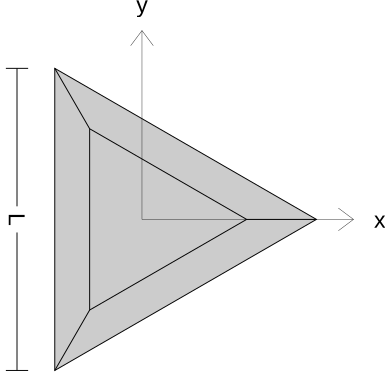
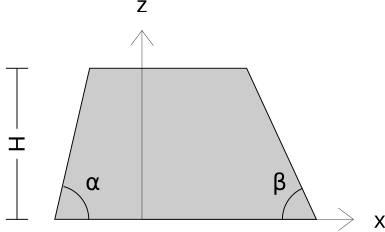
Pyramid3(L, H, alpha)
Parameters:
The angle must satisfy
$$0 < \alpha < 180^\circ.$$
For $\alpha<90^\circ$, the upper edge must not become negative, so the height must satisfy
$$H \le \dfrac{\tan\alpha}{2\sqrt3}L.$$
For $\alpha\ge90^\circ$, there is no additional height constraint.
The orthographic projection also shows the angle $\beta$ between the base and a side edge. It is related to the dihedral angle through $\tan\alpha = 2\tan\beta$.
As for any other Form factor.
Class Pyramid3 inherits from the interface class Formfactor.
Form factor computation is based on the generic form factor of a polyhedron provided by libformfactor .
Volume has been validated against $$ V=\dfrac{L^3\tan\alpha}{24}\Big[1-\Big(1-\dfrac{2\sqrt3H}{L\tan\alpha}\Big)^3\Big]. $$
More special:
Scattering by uncorrelated, oriented pyramids for horizontal incidence. Rotation around $z$ axis:
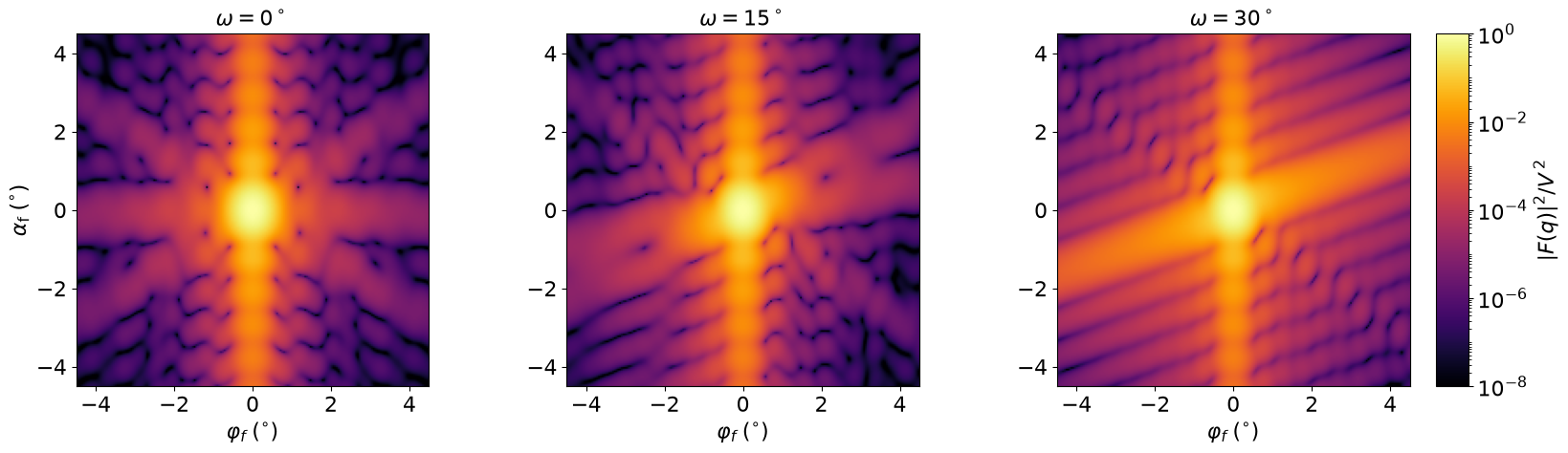
Generated by the SAS form-factor example
(particle_geometry=Pyramid3).
Was incorrectly named “Tetrahedron” up to BornAgain 1.19.
Corresponds to “Tetrahedron” in IsGISAXS Lazzari, IsGISAXS manual v2.6 (2006), Eq. 2.29; Renaud et al, Surf Sci Rep 64, 255 (2009), Eq. 220 and “Truncated tetrahedron” in FitGISAXS Babonneau, FitGISAXS v130531 (2013). In BornAgain 1.6, redefined to let the $x$ axis lie in a mirror plane (rotated by $30^{\circ}$ with respect to the previous version).
Up to BornAgain 1.5, we computed the form factor by numeric integration, as in IsGISAXS. Since BornAgain 1.6 higher speed and accuracy are achieved by using the generic form factor of a polyhedron Wuttke, J Appl Cryst 54, 580 (2021) with series expansions near singularities.