1
  2
  3
  4
  5
  6
  7
  8
  9
 10
 11
 12
 13
 14
 15
 16
 17
 18
 19
 20
 21
 22
 23
 24
 25
 26
 27
 28
 29
 30
 31
 32
 33
 34
 35
 36
 37
 38
 39
 40
 41
 42
 43
 44
 45
 46
 47
 48
 49
 50
 51
 52
 53
 54
 55
 56
 57
 58
 59
 60
 61
 62
 63
 64
 65
 66
 67
 68
 69
 70
 71
 72
 73
 74
 75
 76
 77
 78
 79
 80
 81
 82
 83
 84
 85
 86
 87
 88
 89
 90
 91
 92
 93
 94
 95
 96
 97
 98
 99
100
|
#!/usr/bin/env python3
# /// script
# requires-python = ">=3.10"
# dependencies = ["bornagain>=25,<26"]
# ///
"""
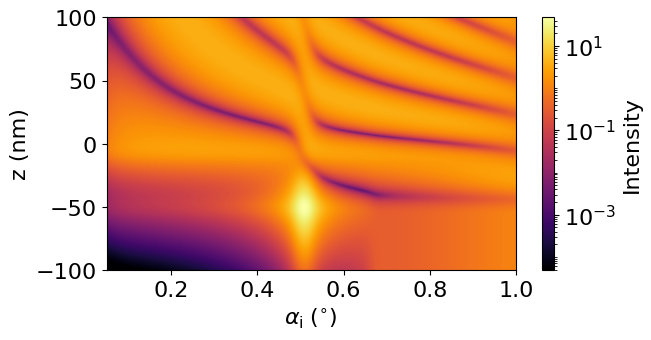
Basic example of depth-probe simulation with BornAgain.

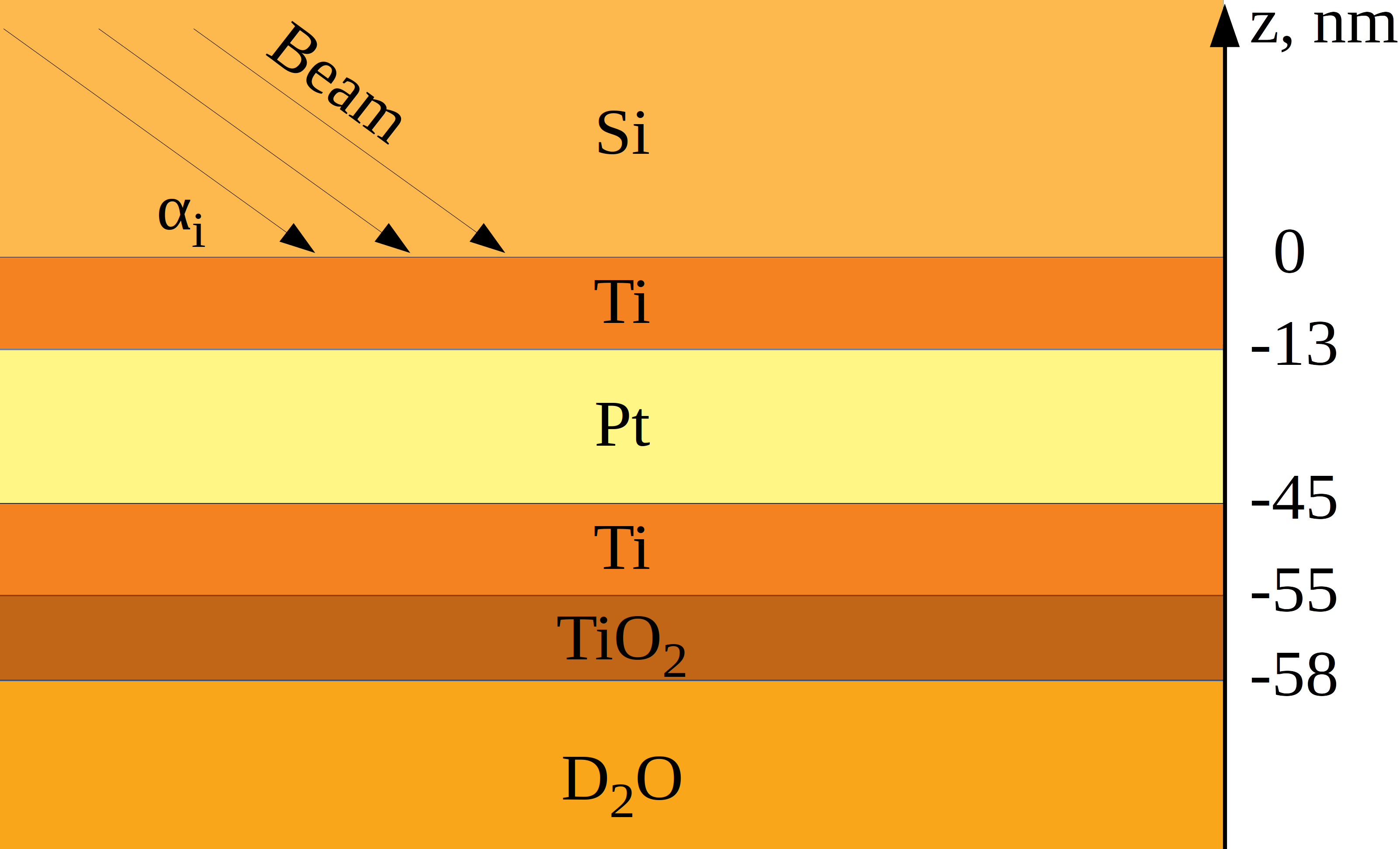
Sample layers are Si | Ti | Pt | Ti | TiO2 | D2O.
Beam comes from Si side.
Therefore we model the stack with Si on top.
The z axis points from D2O to Si; z=0 is at the Si/Ti interface.
"""
import bornagain as ba
ba.require_versions("bornagain>=25,<26")
from bornagain import angstrom, deg, nm


# layer thicknesses in angstroms
t_Ti = 130*angstrom
t_Pt = 320*angstrom
t_Ti_top = 100*angstrom
t_TiO2 = 30*angstrom

#  beam data
ai_min = 0.05*deg  # min incident angle; divergence samples stay above horizon
ai_max = 1*deg  # maximum incident angle
wl = 10*angstrom  # wavelength

# convolution parameters
d_ang = 0.01*ba.deg  # spread width for incident angle

#  depth position span
z_min = -100*nm
z_max = 100*nm


def get_sample():
    """
    Constructs a sample with one resonating Ti/Pt layer
    """

    # Materials
    d2o_color = (0.90, 0.93, 0.97)
    d2o_mat = ba.RefractiveMaterial("D2O", d2o_color, 0.00010116, 1.809e-12)
    pt_color = (0.93, 0.72, 0.25)
    pt_mat = ba.RefractiveMaterial("Pt", pt_color, 0.00010117, 3.01822e-08)
    si_color = (0.30, 0.62, 0.86)
    si_mat = ba.RefractiveMaterial("Si", si_color, 3.3009e-05, 0)
    ti_color = (0.05, 0.62, 0.55)
    ti_mat = ba.RefractiveMaterial("Ti", ti_color, -3.0637e-05, 1.5278e-08)
    tio2_color = (0.48, 0.32, 0.80)
    tio2_mat = ba.RefractiveMaterial("TiO2", tio2_color, 4.1921e-05, 8.1293e-09)

    # Layers
    layer_1 = ba.Layer(si_mat)
    layer_2 = ba.Layer(ti_mat, 13*nm)
    layer_3 = ba.Layer(pt_mat, 32*nm)
    layer_4 = ba.Layer(ti_mat, 10*nm)
    layer_5 = ba.Layer(tio2_mat, 3*nm)
    layer_6 = ba.Layer(d2o_mat)

    # Sample
    sample = ba.Sample()
    sample.addLayer(layer_1)
    sample.addLayer(layer_2)
    sample.addLayer(layer_3)
    sample.addLayer(layer_4)
    sample.addLayer(layer_5)
    sample.addLayer(layer_6)

    return sample


def get_simulation(sample):
    """
    A depth-probe simulation.
    """
    nz = 500
    na = 5000

    scan = ba.AlphaScan(na, ai_min, ai_max)
    scan.setWavelength(wl)

    alpha_distr = ba.DistributionGaussian(0, d_ang, 25, 3.)
    scan.setGrazingAngleDistribution(alpha_distr)

    z_axis = ba.EquiDivision("z (nm)", nz, z_min, z_max)
    simulation = ba.DepthprobeSimulation(scan, sample, z_axis)

    return simulation


if __name__ == '__main__':
    sample = get_sample()
    simulation = get_simulation(sample)
    result = simulation.simulate()
    ba.showSample3D(sample, sample_size=160*nm, seed=0)
    ba.plot_datafield(result, frame_aspect=1.618)
    ba.plt.show()
|
 BornAgain
≻ git-develop
≻ Documentation ≻ Reference ≻ Simulation model ≻ Simulation classes ≻ Depth probe ≻ Resonator
BornAgain
≻ git-develop
≻ Documentation ≻ Reference ≻ Simulation model ≻ Simulation classes ≻ Depth probe ≻ Resonator