 BornAgain
≻ git-develop
≻ Documentation ≻ Reference ≻ Sample model ≻ Structure ≻ 2D structures ≻ 2D paracrystal
BornAgain
≻ git-develop
≻ Documentation ≻ Reference ≻ Sample model ≻ Structure ≻ 2D structures ≻ 2D paracrystal
BornAgain
≻ git-develop
≻ Documentation ≻ Reference ≻ Sample model ≻ Structure ≻ 2D structures ≻ 2D paracrystal
BornAgain
≻ git-develop
≻ Documentation ≻ Reference ≻ Sample model ≻ Structure ≻ 2D structures ≻ 2D paracrystal
Scattering from monodisperse cylinders distributed along a two-dimensional square paracrystal.
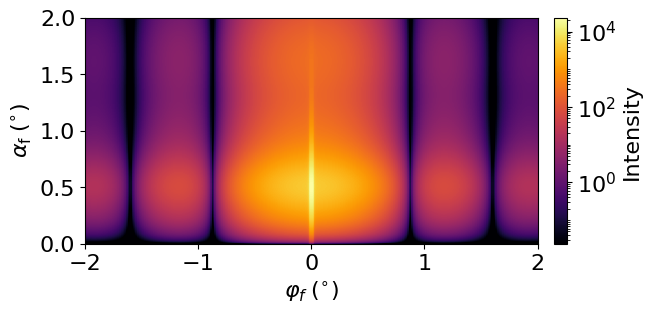
Scattering intensity
Similarly to the 2D crystal structure, the 2D paracrystal is used to model the scattering from particles positioned at regular intervals on a plane. The 2D paracrystal model, however, possesses only short-range order. The disorder is cumulative at further distance.
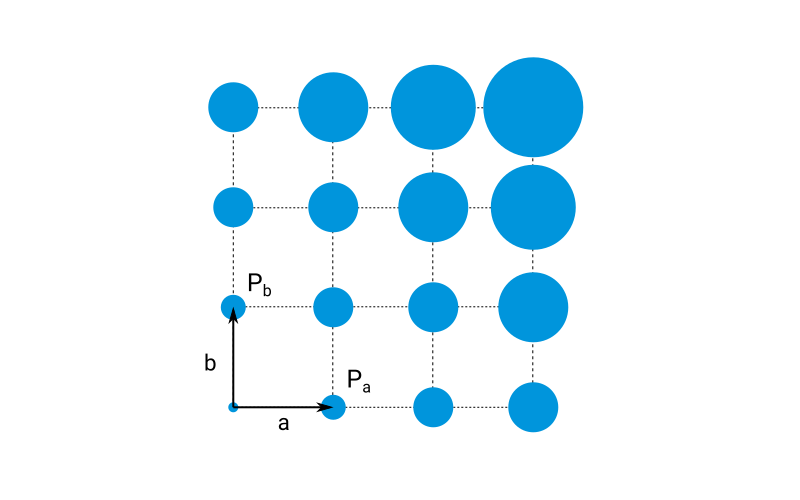
The plot above represents a schematic view of the 2D paracrystal. Each circle on the plot represents an area where the probability to find a particle, given a particle at the origin, is above some arbitrary threshold. The growing size of the areas emphasizes the fact that our knowledge about the next neighbor’s location decreases with the distance to the origin.
The two-dimensional paracrystal model in BornAgain is implemented as a simple convolution of two one-dimensional paracrystals along the lattice basis directions.
Create the lattice first, then construct the paracrystal from the particle and that lattice:
lattice = ba.BasicLattice2D(length1, length2, alpha, xi)
structure = ba.Paracrystal2D(
    particle, lattice, damping_length, domain_size_1, domain_size_2
)
Arguments:
length1, length2  # lattice-vector lengths, in nanometers
alpha             # angle between lattice vectors, in radians
xi                # lattice rotation with respect to the x axis, in radians
damping_length    # damping/coherence length, in nanometers
domain_size_1     # coherent-domain size along first lattice vector
domain_size_2     # coherent-domain size along second lattice vector
For square and hexagonal unit cells, use the convenience lattice classes:
lattice = ba.SquareLattice2D(lattice_constant, xi)
lattice = ba.HexagonalLattice2D(lattice_constant, xi)
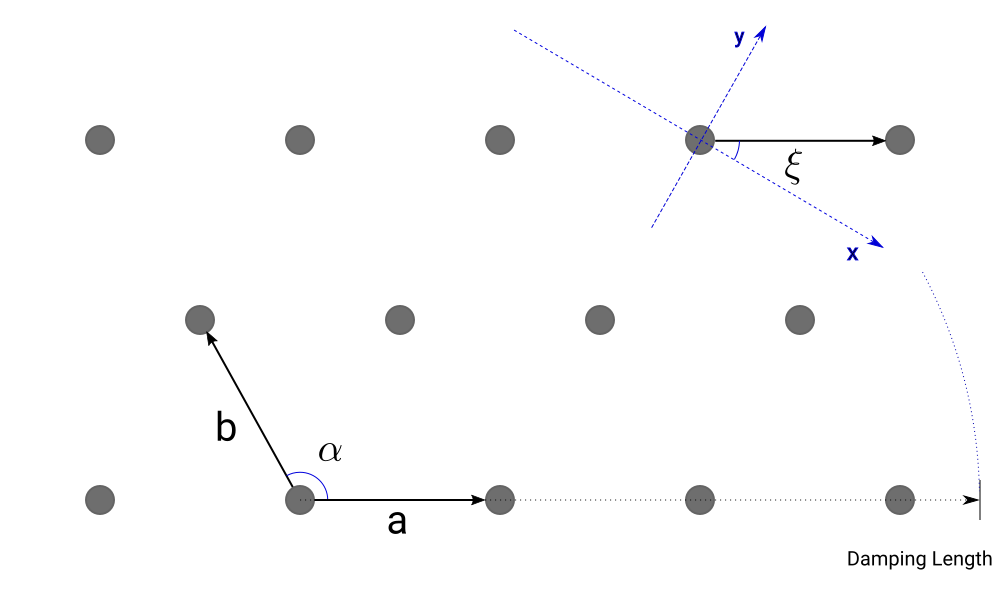
When the beam azimuthal angle $\varphi_f$ is zero, the beam direction coincides with x-axis of the reference frame, so angle $\xi$ can be considered as the lattice rotation with respect to the beam.
The parameter damping_length is used to introduce finite size effects by
applying a multiplicative coefficient equal to
exp(-lattice_constant/damping_length) to the Fourier transform of the
probability density of a nearest neighbor. damping_length equal to 0 means
no damping-length correction.
To account for next neighbor position uncertainty, assign probability
distributions with setProbabilityDistributions(pdf1, pdf2).
profile_1 = ba.Profile2DCauchy(30*nm, 30*nm, 0)
profile_2 = ba.Profile2DCauchy(30*nm, 30*nm, 0)
structure.setProbabilityDistributions(profile_1, profile_2)
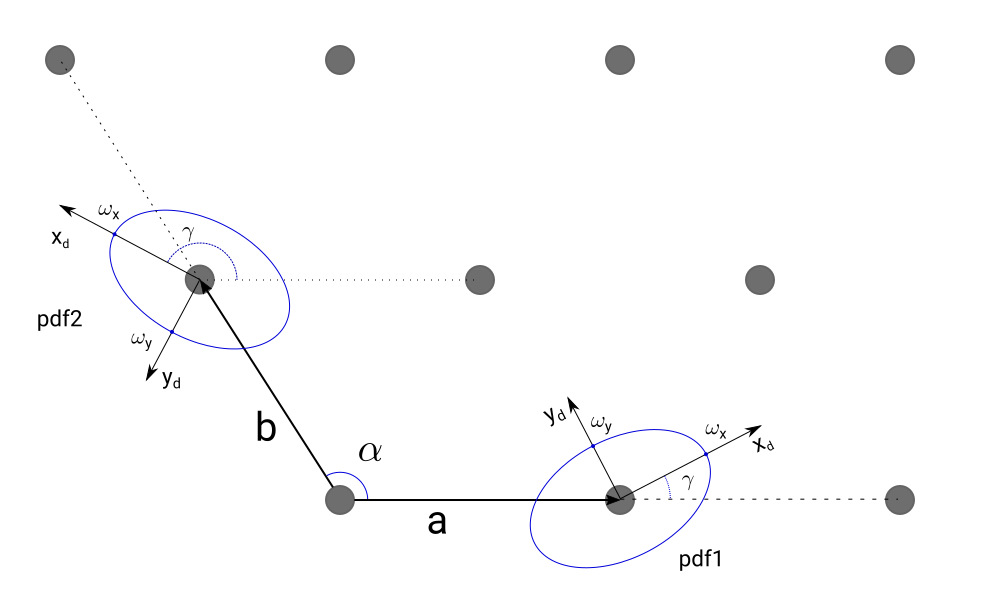
The probability distribution is parameterized with its type, size and
orientation with respect to the lattice vector. $x_d$, $y_d$ on the plot below
represent an orthonormal coordinate system of the distribution in real space
which is rotated by the angle gamma with respect to the lattice vector.
pdf1 is defined for lattice vector $a$, and pdf2 for lattice vector $b$.
The available distribution shapes and their constructors are described under correlation profiles.
The 2D paracrystal provides a way to calculate the scattering from a finite
portion of the paracrystal using the setDomainSizes(size1, size2) method.
Here size1, size2 are given in nanometers and represent the sizes of the
coherence domains in the first and second lattice directions.
lattice = ba.SquareLattice2D(20*nm, 0)
structure = ba.Paracrystal2D(particle, lattice, 0, 0, 0)
structure.setProbabilityDistributions(
    ba.Profile2DCauchy(30*nm, 30*nm, 0),
    ba.Profile2DCauchy(30*nm, 30*nm, 0),
)
structure.setDomainSizes(10000*nm, 10000*nm)
The paracrystal can be averaged over all azimuthal angles $\xi$ using the
setIntegrationOverXi(True) method. In this case the initial lattice rotation
angle $\xi$, if set, will be ignored and numeric integration will be performed
for $\xi$ in the range 0 to 360 degrees. Averaging provides a convenient way
of getting an isotropic structure at the cost of longer computation time.
structure.setIntegrationOverXi(True)
The Hex paracrystal example uses this orientation averaging.
The particle density is determined from the 2D lattice parameters. There is no
separate particle-density setting for Paracrystal2D.