 BornAgain
≻ git-develop
≻ Documentation ≻ Reference ≻ Sample model ≻ Particles ≻ Form factor ≻ Hard particles ≻ Pyramid2
BornAgain
≻ git-develop
≻ Documentation ≻ Reference ≻ Sample model ≻ Particles ≻ Form factor ≻ Hard particles ≻ Pyramid2
BornAgain
≻ git-develop
≻ Documentation ≻ Reference ≻ Sample model ≻ Particles ≻ Form factor ≻ Hard particles ≻ Pyramid2
BornAgain
≻ git-develop
≻ Documentation ≻ Reference ≻ Sample model ≻ Particles ≻ Form factor ≻ Hard particles ≻ Pyramid2
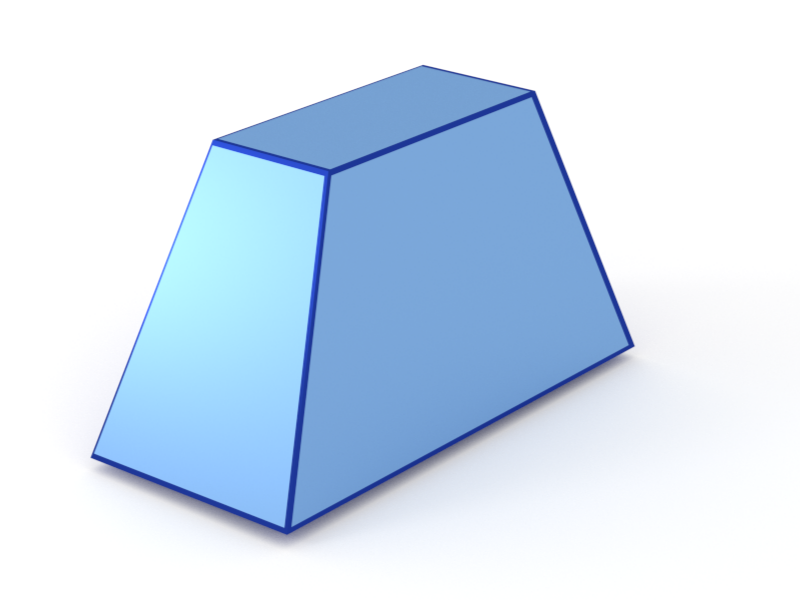
A truncated pyramid with rectangular base.
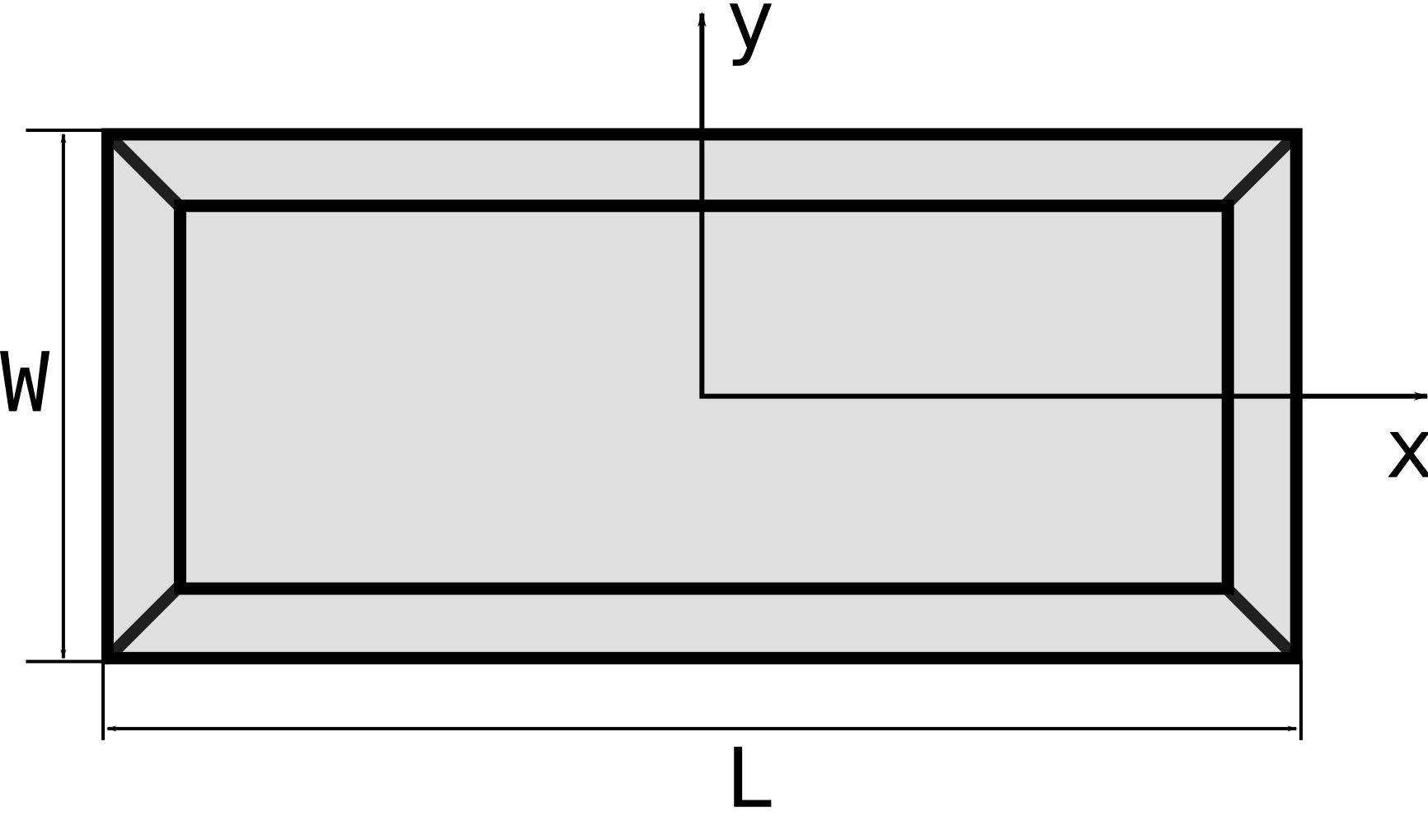
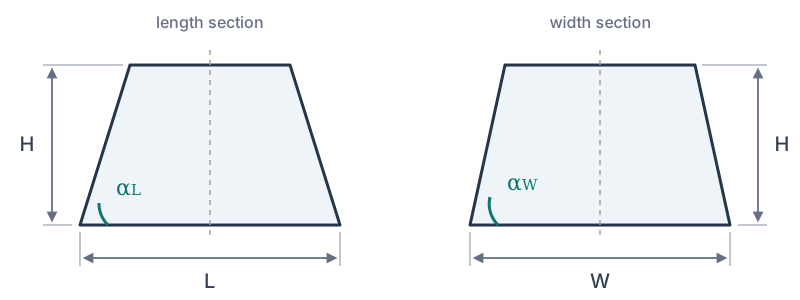
Pyramid2(L, W, H, alpha_L, alpha_W)
Parameters:
For equal taper angles in both directions, pass the same value for alpha_L
and alpha_W.
Each angle must satisfy
$$0 < \alpha_L,\alpha_W < 180^\circ.$$
For an angle below $90^\circ$, the corresponding top-face dimension must not be negative:
$$L \geq \dfrac{2H}{\tan\alpha_L}, \qquad W \geq \dfrac{2H}{\tan\alpha_W}.$$
For an angle at least $90^\circ$, there is no additional constraint in that direction and the upper face has the same or a larger extent than the base.
As for any other Form factor.
Class Pyramid2 inherits from the interface class Formfactor.
Form factor computation is based on the generic form factor of a polyhedron provided by libformfactor .
Volume has been validated against $$ V=H\left[LW-\dfrac{WH}{\tan\alpha_L}-\dfrac{LH}{\tan\alpha_W} +\dfrac{4H^2}{3\tan\alpha_L\tan\alpha_W}\right]. $$
More special:
Scattering by uncorrelated, oriented pyramids for horizontal incidence. Rotation around $z$ axis:
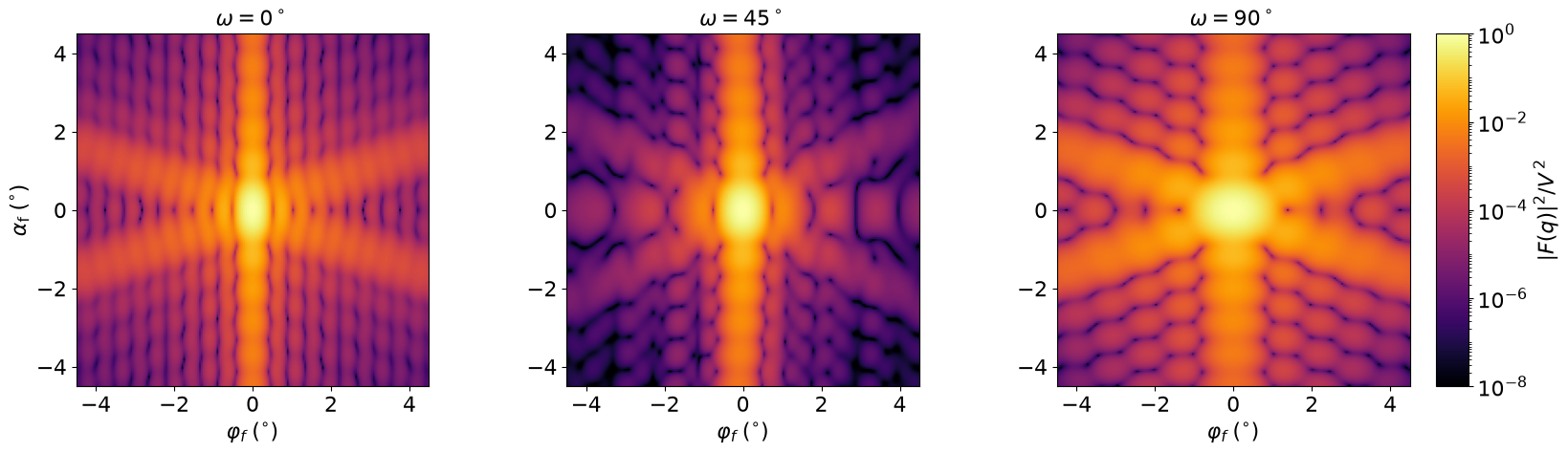
Generated by the SAS form-factor example
(particle_geometry=Pyramid2).
Was named “AnisoPyramid” up to BornAgain 1.19.
Agrees with the “In plane anisotropic pyramid” form factor of IsGISAXS Lazzari, IsGISAXS manual v2.6 (2006), Eq. 2.38-2.39; Renaud et al, Surf Sci Rep 64, 255 (2009), Eq. 216-217, except for different parametrization. This is not the “Anisotropic pyramid” of FitGISAXS, which is a true pyramid with an off-center apex Babonneau, FitGISAXS v130531 (2013).