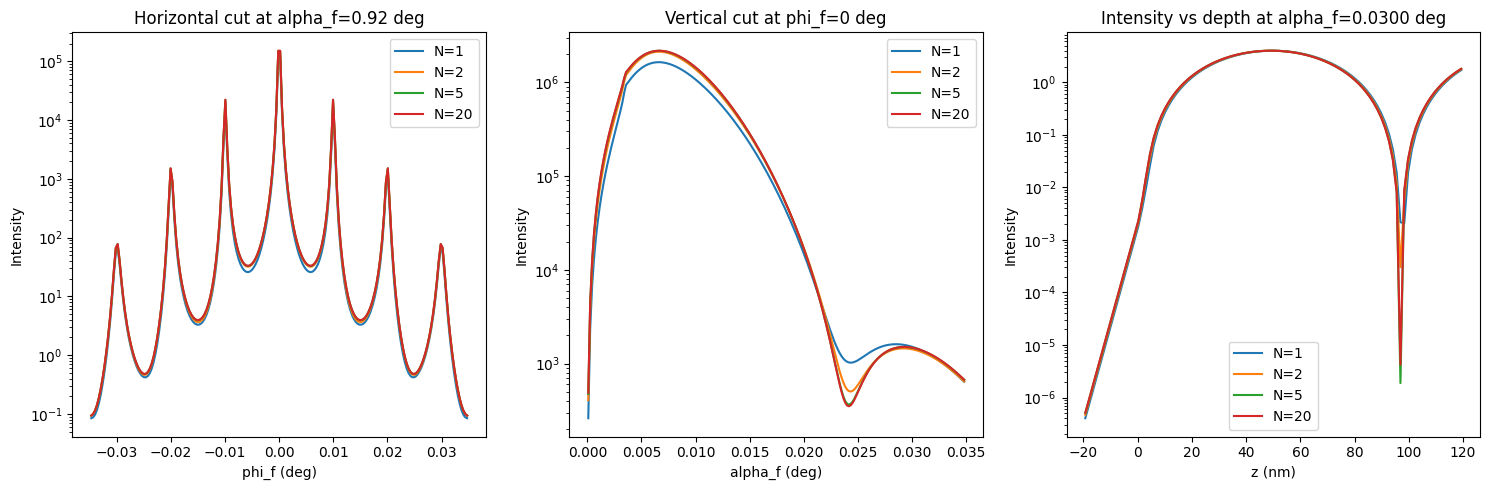
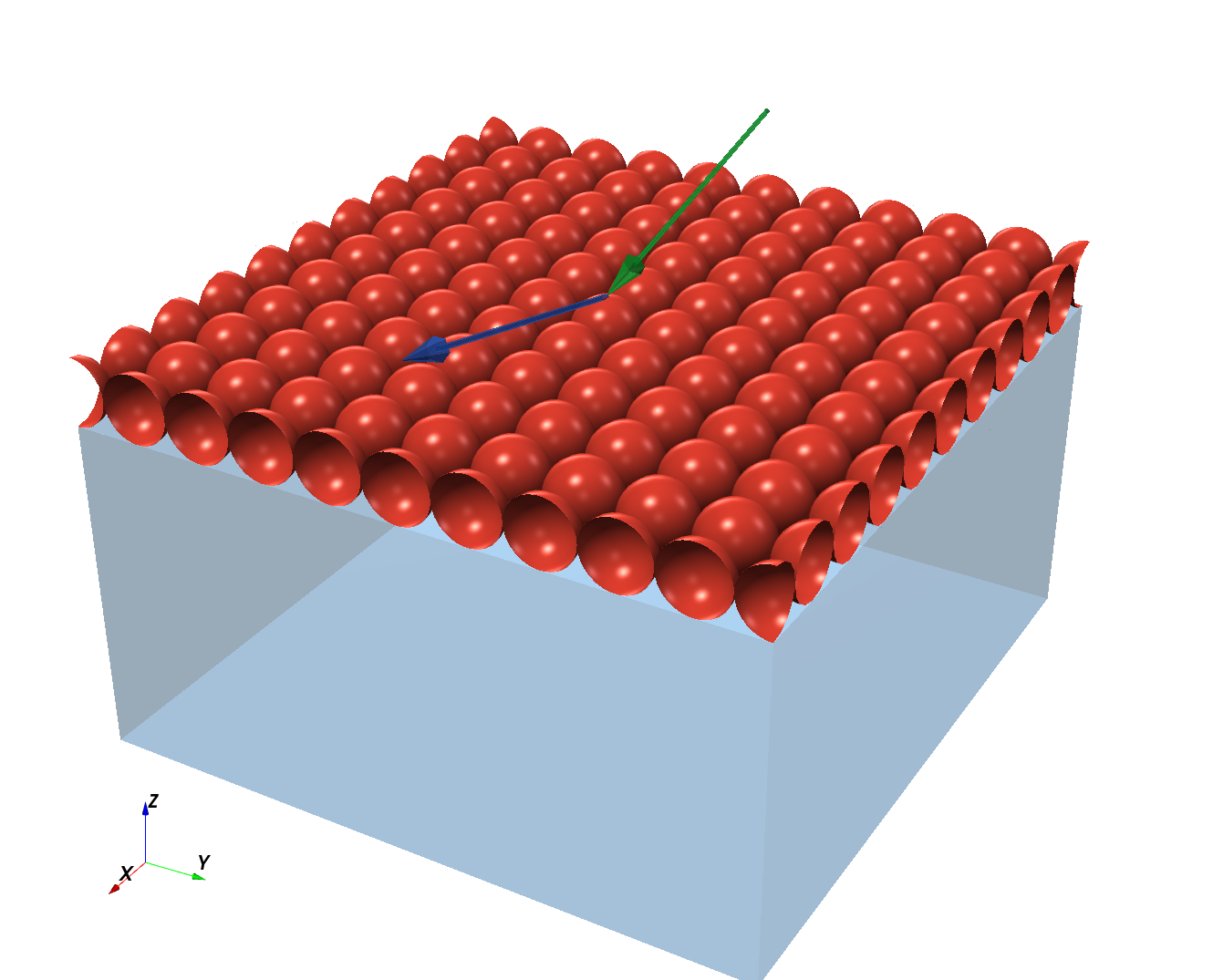
1
  2
  3
  4
  5
  6
  7
  8
  9
 10
 11
 12
 13
 14
 15
 16
 17
 18
 19
 20
 21
 22
 23
 24
 25
 26
 27
 28
 29
 30
 31
 32
 33
 34
 35
 36
 37
 38
 39
 40
 41
 42
 43
 44
 45
 46
 47
 48
 49
 50
 51
 52
 53
 54
 55
 56
 57
 58
 59
 60
 61
 62
 63
 64
 65
 66
 67
 68
 69
 70
 71
 72
 73
 74
 75
 76
 77
 78
 79
 80
 81
 82
 83
 84
 85
 86
 87
 88
 89
 90
 91
 92
 93
 94
 95
 96
 97
 98
 99
100
101
102
103
104
105
106
107
108
109
110
111
112
113
114
115
116
117
118
119
120
121
122
123
124
125
126
127
128
129
130
131
132
133
134
135
136
|
#!/usr/bin/env python3
# /// script
# requires-python = ">=3.10"
# dependencies = ["bornagain>=25,<26"]
# ///
"""
Square lattice of half spheres on substrate.
Test to investigate intensity changes with different numbers of slices.
"""
import bornagain as ba
ba.require_versions("bornagain>=25,<26")
from bornagain import deg, nm


def get_sample(n_slices=1):
    # Materials (zero absorption)
    particle_color = (0.86, 0.24, 0.18)
    particle_mat = ba.RefractiveMaterial("Particle", particle_color, 3e-05, 0)
    substrate_color = (0.28, 0.57, 0.82)
    substrate_mat = ba.RefractiveMaterial("Substrate", substrate_color, 6e-06, 0)
    vacuum = ba.Vacuum()

    # Particles
    ff = ba.SphericalSegment(5*nm, 0, 5*nm)
    particle = ba.Particle(particle_mat, ff)

    # 2D lattices
    lattice = ba.BasicLattice2D(10*nm, 10*nm, 90*deg, 0)

    # Interference functions
    layout = ba.Crystal2D(particle, lattice)
    profile = ba.Profile2DCauchy(100*nm, 100*nm, 0)
    layout.setDecayFunction(profile)

    # Layers
    layer_1 = ba.Layer(vacuum)
    if n_slices > 1:
        layer_1.setNumberOfSlices(n_slices)
    layer_1.deposit2D(layout)
    layer_2 = ba.Layer(substrate_mat)

    # Sample
    sample = ba.Sample()
    sample.addLayer(layer_1)
    sample.addLayer(layer_2)

    return sample


def simulate_horizontal_cut(n_slices=1):
    """
    Simulate with Nx1 detector for horizontal cut at alpha_f=0.92 deg.
    """
    sample = get_sample(n_slices)
    beam = ba.Beam(1e9, 0.1*nm, 0.2*deg)
    n = 200
    # Single bin centered at alpha_f=0.92 deg
    detector = ba.SphericalDetector(n, -2*deg, 2*deg, 1, 0.91*deg, 0.93*deg)
    simulation = ba.ScatteringSimulation(beam, sample, detector)
    return simulation.simulate()


def simulate_vertical_cut(n_slices=1):
    """
    Simulate with 1xN detector for vertical cut at phi_f=0 deg.
    """
    sample = get_sample(n_slices)
    beam = ba.Beam(1e9, 0.1*nm, 0.2*deg)
    n = 200
    # Single bin centered at phi_f=0 deg
    detector = ba.SphericalDetector(1, -0.01*deg, 0.01*deg, n, 0, 2*deg)
    simulation = ba.ScatteringSimulation(beam, sample, detector)
    return simulation.simulate()


def simulate_depthprobe(n_slices=1):
    """
    Simulate intensity vs depth.
    """
    sample = get_sample(n_slices)
    n = 100
    alpha_f = 0.03*deg
    scan = ba.AlphaScan([alpha_f])
    scan.setWavelength(0.1*nm)
    z_axis = ba.EquiDivision("z (nm)", n, -20*nm, 120*nm)
    simulation = ba.DepthprobeSimulation(scan, sample, z_axis)
    return simulation.simulate(), alpha_f/deg


# Color cycle for different N values
colors = ['C0', 'C1', 'C2', 'C3']


if __name__ == '__main__':
    # Slice counts to compare
    slice_counts = [1, 2, 5, 20]

    # Create figure with 1 row, 3 columns
    fig, axes = ba.plt.subplots(1, 3, figsize=(15, 5))

    # Horizontal cuts at alpha_f=0.92 deg
    ax = axes[0]
    for i, n in enumerate(slice_counts):
        result = simulate_horizontal_cut(n_slices=n)
        ax.semilogy(result.xCenters(), result.flatVector(),
                    label=f'N={n}', color=colors[i])
    ax.set_title('Horizontal cut at alpha_f=0.92 deg')
    ax.set_xlabel('phi_f (deg)')
    ax.set_ylabel('Intensity')
    ax.legend()

    # Vertical cuts at phi_f=0 deg
    ax = axes[1]
    for i, n in enumerate(slice_counts):
        result = simulate_vertical_cut(n_slices=n)
        ax.semilogy(result.yCenters(), result.flatVector(),
                    label=f'N={n}', color=colors[i])
    ax.set_title('Vertical cut at phi_f=0 deg')
    ax.set_xlabel('alpha_f (deg)')
    ax.set_ylabel('Intensity')
    ax.legend()

    # Intensity vs depth
    ax = axes[2]
    for i, n in enumerate(slice_counts):
        result, alpha_f = simulate_depthprobe(n_slices=n)
        ax.semilogy(result.yCenters(), result.flatVector(),
                    label=f'N={n}', color=colors[i])
    ax.set_title(f'Intensity vs depth at alpha_f={alpha_f:.4f} deg')
    ax.set_xlabel('z (nm)')
    ax.set_ylabel('Intensity')
    ax.legend()

    ba.plt.tight_layout()
    ba.showSample3D(get_sample(), sample_size=100*nm, seed=0)
    ba.plt.show()
|
 BornAgain
≻ git-develop
≻ Documentation ≻ Examples ≻ GISAS ≻ Particles, layers, and interfaces ≻ Half spheres slices
BornAgain
≻ git-develop
≻ Documentation ≻ Examples ≻ GISAS ≻ Particles, layers, and interfaces ≻ Half spheres slices