 BornAgain
≻ git-develop
≻ Documentation ≻ Reference ≻ Sample model ≻ Structure ≻ 2D structures ≻ Disorder
BornAgain
≻ git-develop
≻ Documentation ≻ Reference ≻ Sample model ≻ Structure ≻ 2D structures ≻ Disorder
BornAgain
≻ git-develop
≻ Documentation ≻ Reference ≻ Sample model ≻ Structure ≻ 2D structures ≻ Disorder
BornAgain
≻ git-develop
≻ Documentation ≻ Reference ≻ Sample model ≻ Structure ≻ 2D structures ≻ Disorder
To add a dilute random assembly of uncorrelated particles to a layer:
structure = ba.Dilute2D(density, particle)

layer.deposit2D(structure)
layer.suspend2D(structure)
Argument density is the number density in nm$^{-2}$.
For argument particle, see Particle.
With deposit2D, the bottom of the particle is placed at the layer’s bottom
interface. This is appropriate for particles sitting on a substrate. This mode
must only be used for finite-thickness layers, not for the semi-infinite
bottom (substrate) or top (ambient) layer.
With suspend2D, the top of the particle is placed at the layer’s top
interface. This is appropriate for particles hanging from below an interface,
such as particles embedded in a substrate just below its top surface. This
mode can be used for finite-thickness layers or the semi-infinite bottom
(substrate) layer.
For soft particles with diffuse boundaries, translate the particle before creating the structure if its center should be shifted away from the default anchor plane.
For an incoherent mixture of particle variants that share the same structure,
pass a particle Mixture to
Dilute2D or Dense2D.
To add a dense random assembly of non-overlapping but otherwise non-interacting particles to a layer:
structure = ba.Dense2D(density, particle)

layer.deposit2D(structure)
layer.suspend2D(structure)
The scattering is computed in Percus-Yevick approximation, using the approximative structure factor of M.S. Ripoll & C.F. Tejero (1995).
Use the appropriate layer function (deposit2D or suspend2D) according to
the positioning rules described above.
The Hard disk example shows a complete
simulation with Dense2D.
In the following example, the sample is a dense random assembly of disks on a substrate. GISAS has been simulated (a) assuming that the disks are completely uncorrelated, as in an ideal gas, and (b) taking into account that the disks cannot overlap, using the hard-disk liquid model. The figure shows horizontal cuts through these GISAS patterns.
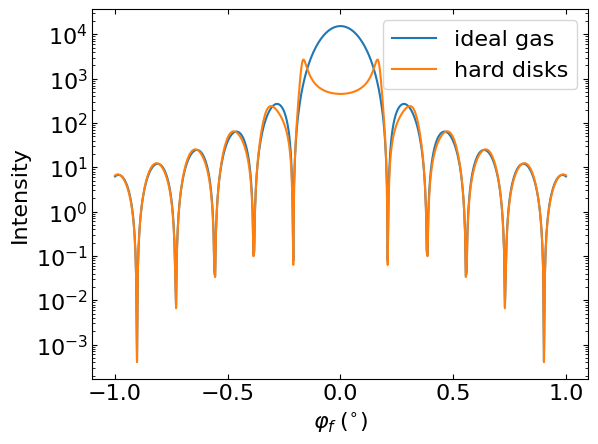
GISAS intensity at $\alpha_f=0.8^\circ$