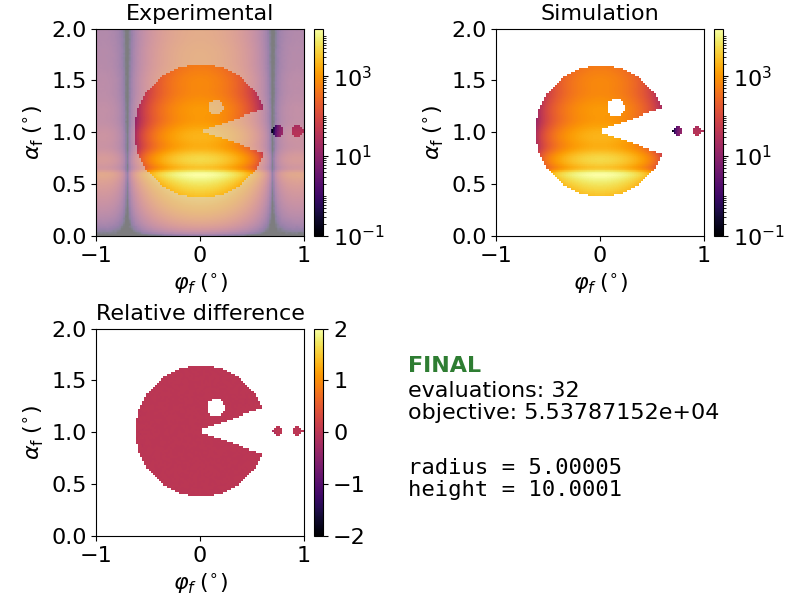
1
  2
  3
  4
  5
  6
  7
  8
  9
 10
 11
 12
 13
 14
 15
 16
 17
 18
 19
 20
 21
 22
 23
 24
 25
 26
 27
 28
 29
 30
 31
 32
 33
 34
 35
 36
 37
 38
 39
 40
 41
 42
 43
 44
 45
 46
 47
 48
 49
 50
 51
 52
 53
 54
 55
 56
 57
 58
 59
 60
 61
 62
 63
 64
 65
 66
 67
 68
 69
 70
 71
 72
 73
 74
 75
 76
 77
 78
 79
 80
 81
 82
 83
 84
 85
 86
 87
 88
 89
 90
 91
 92
 93
 94
 95
 96
 97
 98
 99
100
101
102
103
104
105
106
107
108
109
110
111
112
113
114
115
116
117
118
119
120
121
122
123
124
125
126
127
128
129
130
131
132
133
134
135
136
137
138
139
140
141
142
143
144
145
146
147
148
149
150
151
152
153
154
155
156
157
158
159
160
161
162
163
164
165
166
167
168
169
|
#!/usr/bin/env python3
# /// script
# requires-python = ">=3.10"
# dependencies = ["bornagain>=25,<26", "lmfit"]
# ///
"""
Fitting example: fit with masks
"""

import bornagain as ba
ba.require_versions("bornagain>=25,<26")
from bornagain import deg, nm, nm2
import lmfit
import numpy as np


def get_sample(P):
    """
    Uncorrelated cylinders on a substrate, parameterized for fitting.
    """
    substrate_color = (0.28, 0.57, 0.82)
    particle_color = (0.86, 0.24, 0.18)

    substrate_mat = ba.RefractiveMaterial("Substrate", substrate_color, 6e-6, 2e-8)
    particle_mat = ba.RefractiveMaterial("Particle", particle_color, 6e-4, 2e-8)
    particle = ba.Particle(particle_mat, ba.Cylinder(P["radius"], P["height"]))

    particle_layer = ba.Layer(ba.Vacuum())
    # Modest coverage keeps material averaging physical over the fit bounds.
    particle_layer.deposit2D(ba.Dilute2D(1e-3/nm2, particle))

    sample = ba.Sample()
    sample.addLayer(particle_layer)
    sample.addLayer(ba.Layer(substrate_mat))
    return sample


def get_simulation(P):
    """
    GISAS simulation for the parameterized cylinder sample.
    """
    n = 101
    beam = ba.Beam(1e8, 0.1*nm, 0.2*deg)
    detector = ba.SphericalDetector(n, -1*deg, 1*deg, n, 0, 2*deg)
    simulation = ba.ScatteringSimulation(beam, get_sample(P), detector)
    return simulation


def fake_data():
    """
    Generate noisy synthetic data for a known cylinder sample.
    """
    P = {"radius": 5*nm, "height": 10*nm}
    return get_simulation(P).simulate().noisy(0.1, 0.1)


def get_masked_simulation(P):
    """
    GISAS simulation with a Python-generated detector mask.
    """
    n = 101
    beam = ba.Beam(1e8, 0.1*nm, 0.2*deg)
    sample = get_sample(P)
    detector = ba.SphericalDetector(n, -1*deg, 1*deg, n, 0, 2*deg)
    add_mask_to_detector(detector)
    simulation = ba.ScatteringSimulation(beam, sample, detector)
    return simulation


def add_mask_to_detector(detector):
    """
    Adds a Python-generated detector bitmap mask to the detector.
    """
    n_phi = detector.axis(0).size()
    n_alpha = detector.axis(1).size()

    y, x = np.ogrid[:n_alpha, :n_phi]
    x0 = 0.5*n_phi
    y0 = 0.5*n_alpha
    r = 0.32*min(n_phi, n_alpha)

    mask = np.ones((n_alpha, n_phi), dtype=bool)

    head = (x - x0)**2 + (y - y0)**2 <= r**2
    eye = (x - (x0 + 0.22*r))**2 + (y - (y0 + 0.35*r))**2 <= (0.11*r)**2
    mouth = (x > x0) & (np.abs(y - y0) < 0.35*(x - x0))
    mask[head] = False
    mask[eye] = True
    mask[mouth] = True

    for center in (x0 + 1.15*r, x0 + 1.45*r, x0 + 1.75*r):
        snack = (x - center)**2 + (y - y0)**2 <= (0.09*r)**2
        mask[snack] = False

    detector.setMask(mask)


def get_plotters(exp_data):
    """
    Creates the fit-progress plotters.
    """
    norm = ba.intensity_norm(exp_data)

    experiment_plotter = ba.FitPlotter(
        ba.plot_masked_experimental,
        context_data=exp_data,
        norm=norm,
        with_cb=True,
        title="Experimental",
    )

    simulation_plotter = ba.FitPlotter(
        ba.plot_heatmap,
        norm=norm,
        with_cb=True,
        title="Simulation",
    )

    difference_plotter = ba.FitPlotter(
        ba.plot_difference,
        context_data=exp_data,
        with_cb=True,
        title="Relative difference",
    )

    return [
        experiment_plotter,
        simulation_plotter,
        difference_plotter,
    ]


if __name__ == '__main__':
    exp_data = fake_data()
    exp_values = exp_data.intensities()

    # Fit progress display
    monitor = ba.FitMonitor(
        get_plotters(exp_data),
        ncols=2,
        show_best=True,
        max_fps=1,
        printer=ba.Printer(every_nth=10),
        live=True)

    def residuals(P):
        """
        Simulates and reports residuals; masked pixels contribute zero.
        """
        sim_result = get_masked_simulation(P.valuesdict()).simulate()
        residuals = ba.valid_pixel_residual(exp_values,
                                                sim_result.intensities())
        monitor.update(sim_result, P, residuals)
        return residuals

    P = lmfit.Parameters()
    P.add("radius", value=6*nm, min=4*nm, max=8*nm)
    P.add("height", value=9*nm, min=8*nm, max=12*nm)

    result = lmfit.minimize(residuals, P, method="leastsq")

    finalP = result.params.valuesdict()
    # Recompute and report the simulation at the fitted parameters.
    residuals(result.params)
    # Render the just-reported evaluation as the final fit state.
    monitor.render_final(result.params)
    print(lmfit.fit_report(result))
    ba.showSample3D(get_sample(finalP), sample_size=120*nm, seed=0)
    ba.plt.show()
|