 BornAgain
≻ git-develop
≻ Documentation ≻ Reference ≻ Simulation model ≻ Simulation classes ≻ Scattering ≻ Examples ≻ GISAS
BornAgain
≻ git-develop
≻ Documentation ≻ Reference ≻ Simulation model ≻ Simulation classes ≻ Scattering ≻ Examples ≻ GISAS
BornAgain
≻ git-develop
≻ Documentation ≻ Reference ≻ Simulation model ≻ Simulation classes ≻ Scattering ≻ Examples ≻ GISAS
BornAgain
≻ git-develop
≻ Documentation ≻ Reference ≻ Simulation model ≻ Simulation classes ≻ Scattering ≻ Examples ≻ GISAS
The following introductory example simulates a dilute random assembly of monodisperse cylindrical disks on a substrate.
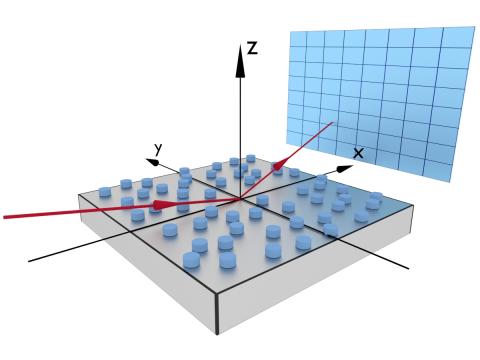
Real-space model
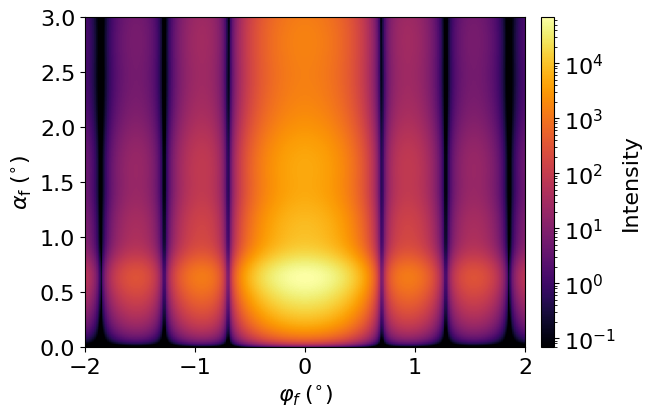
Scattering intensity
|
|
The simulation of type ScatteringSimulation is defined by beam, sample, and detector.
The incoming beam is defined by the constructor Beam with arguments intensity,
wavelength, and glancing angle.
To define the wavelength, we use the unit multiplier nm.
As it happens, the internal unit for microscopic lengths in BornAgain is one nanometer;
therefore the constant nm is just 1, and *nm could be omitted from the code,
but we recommend to leave it for the benefit of human readers.
The spherical detector has nPix=200 bins for both coordinate axis. The azimuthal angle $\varphi_\text{f}$ extends from $-2^\circ$ to $+2^\circ$; the glancing angle $\alpha_\text{f}$ from $0^\circ$ to $3^\circ$.
The last stanza in the script is the main program. It constructs the sample
and simulation, then calls simulation.simulate() to obtain a
Datafield object and plots it with
ba.plot_datafield.