 BornAgain
≻ git-develop
≻ Documentation ≻ Reference ≻ Sample model ≻ Structure ≻ 2D structures ≻ Size-distribution models
BornAgain
≻ git-develop
≻ Documentation ≻ Reference ≻ Sample model ≻ Structure ≻ 2D structures ≻ Size-distribution models
BornAgain
≻ git-develop
≻ Documentation ≻ Reference ≻ Sample model ≻ Structure ≻ 2D structures ≻ Size-distribution models
BornAgain
≻ git-develop
≻ Documentation ≻ Reference ≻ Sample model ≻ Structure ≻ 2D structures ≻ Size-distribution models
The LMA approach implies that the layer is laterally divided into domains containing particles of the same size and shape and organized into a certain structure. In this approximation the domains are spatially separated and thus completely independent from each other.
The scattering intensity is incoherently summed over the domains with the corresponding weights.
structure_1 = ba.RadialParacrystal(particle_1, 16.8*nm, 1000*nm)
structure_2 = ba.RadialParacrystal(particle_2, 22.8*nm, 1000*nm)
structure_1.setProbabilityDistribution(profile)
structure_2.setProbabilityDistribution(profile)

layer.addDeposit2D(0.5, structure_1)
layer.addDeposit2D(0.5, structure_2)
The DA approach implies that the particles share the common structure but present there with their individual weights. There is still no coherence between different types of particles.
For ordered structures with multiple particle types, use a Mixture:
mix = ba.Mixture()
mix.addParticle(particle_1, 0.8)
mix.addParticle(particle_2, 0.2)

structure = ba.RadialParacrystal(mix, 18*nm, 1000*nm)
structure.setProbabilityDistribution(profile)
layer.deposit2D(structure)
For a disordered case, use independent dilute structures:
layer.deposit2D(ba.Dilute2D(density_1, particle_1))
layer.deposit2D(ba.Dilute2D(density_2, particle_2))
Applicable only to radial paracrystal.
The SSCA approach introduces phase shift between different fractions with the
common structure. This is done by setting parameter kappa to 1 (it is 0 by
default).
mix = ba.Mixture()
mix.addParticle(particle_1, 0.8)
mix.addParticle(particle_2, 0.2)

structure = ba.RadialParacrystal(mix, 18*nm, 1000*nm)
structure.setProbabilityDistribution(profile)
structure.setKappa(1)  # Enable SSCA
layer.deposit2D(structure)
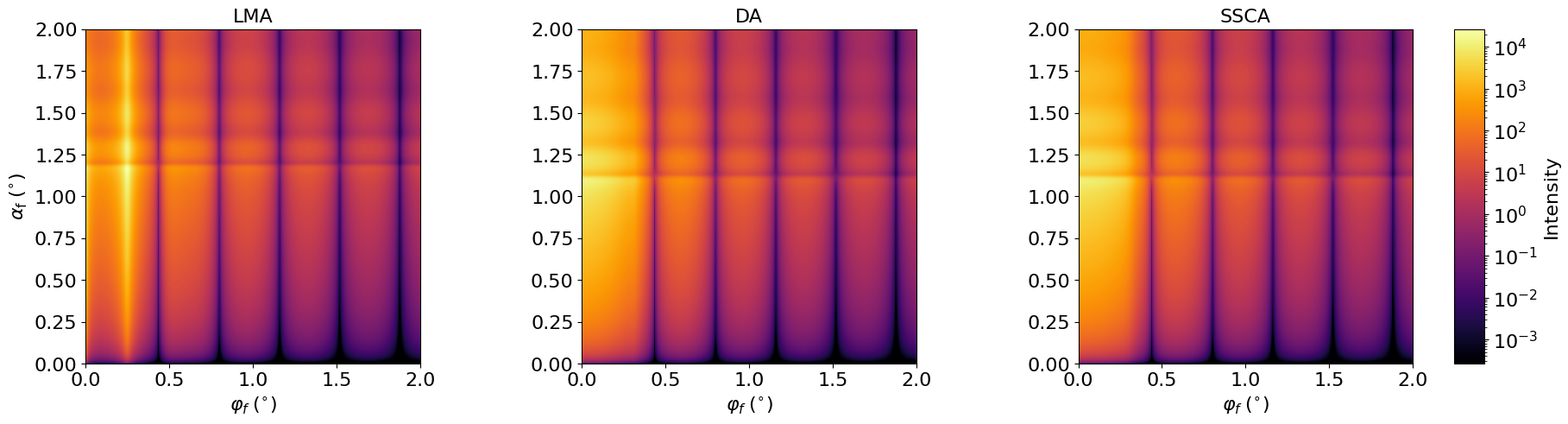
Scattering from a distribution of cylinders of two different sizes, positioned according to the radial paracrystal model.
The example below compares the scattering patterns of all three approximations.
Scattering intensity