 BornAgain
≻ 24
≻ Documentation ≻ Reference ≻ Instrument model ≻ Examples ≻ Neutron polarization ≻ Magnetic layer
BornAgain
≻ 24
≻ Documentation ≻ Reference ≻ Instrument model ≻ Examples ≻ Neutron polarization ≻ Magnetic layer
BornAgain
≻ 24
≻ Documentation ≻ Reference ≻ Instrument model ≻ Examples ≻ Neutron polarization ≻ Magnetic layer
BornAgain
≻ 24
≻ Documentation ≻ Reference ≻ Instrument model ≻ Examples ≻ Neutron polarization ≻ Magnetic layer
This is the introductory example for specular reflectometry with polarized neutrons.
The sample consists of a single magnetic layer on top of a substrate.
The magnetic field vector B lies in the xy plane.
The field direction forms an angle of Bang = 30 * deg with the x axis.
The field magnitude Bmag=1e8 is in units of A/m.
The field is passed as an optional function argument to the constructor
ba.SLDMaterial.
The neutron polarizer and analyzer directions are set through
    scan.setPolarization(polarizer_vec)
    scan.setAnalyzer(analyzer_vec)
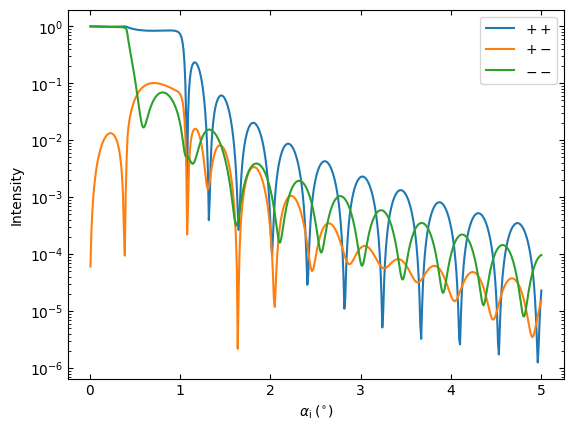
The resulting reflectivities are shown in this plot:
Reflectivity
As expected, we find the birefringent behavior. The critical angles also depends on the polarization.
The curve for polarizer settings -+ is not shown
because it coincides with the +- curve.
Here is the complete example:
|
|