1
2
3
4
5
6
7
8
9
10
11
12
13
14
15
16
17
18
19
20
21
22
23
24
25
26
27
28
29
30
31
32
33
34
35
36
37
38
39
40
41
42
43
44
45
46
47
48
49
50
51
52
53
54
55
56
57
58
59
60
61
62
63
64
65
66
67
68
69
70
71
72
73
74
75
76
77
78
79
80
81
82
83
84
85
86
87
88
89
90
91
92
93
94
95
96
97
98
99
100
101
102
103
104
105
106
107
108
109
110
111
112
113
114
115
116
117
118
119
120
121
122
123
124
125
126
127
128
129
130
131
132
133
134
135
136
137
138
139
140
141
142
143
144
145
146
147
148
149
150
151
152
153
154
155
156
157
158
159
160
161
162
163
164
165
166
167
168
169
170
|
#!/usr/bin/env python3
"""
Generates correlated random rough surfaces for two sample interfaces.
"""
import random
import numpy as np
import bornagain as ba
from bornagain import ba_plot as bp, nm, nm2, nm3
from matplotlib import gridspec
FILM_THICKNESS = 25*nm
CORRELATION_SPLIT_FREQ = 0.035/nm
def correlation(a, b):
return np.corrcoef(a.flatten(), b.flatten())[0, 1]
def frequency_filtered(h, cutoff, keep_low):
fy = np.fft.fftfreq(h.shape[0], d=Ly/h.shape[0])
fx = np.fft.fftfreq(h.shape[1], d=Lx/h.shape[1])
qx, qy = np.meshgrid(fx, fy)
q = np.hypot(qx, qy)
mask = q <= cutoff if keep_low else q >= cutoff
return np.fft.ifft2(np.fft.fft2(h) * mask).real
def psd_line(h):
factor = X_points*Y_points/np.sqrt(Lx*Ly)
n = np.floor(X_points/2 + 1).astype(int)
psd = abs(np.fft.rfft2(h)/factor)**2
psd_points_x = np.array([psd[0][i] for i in range(1, n)])
f_points_x = np.array([i/Lx for i in range(1, n)])
return f_points_x, psd_points_x
def add_map(ax, h, title, vlim):
im = ax.imshow(h, extent=[0, Lx, 0, Ly], cmap='inferno',
vmin=-vlim, vmax=vlim)
ax.set_title(title)
ax.set_xlabel('x, nm')
ax.set_ylabel('y, nm')
bp.plt.colorbar(im, ax=ax, shrink=0.75)
def add_psd(ax, h):
f, psd = psd_line(h)
ax.plot(f, psd)
ax.set_yscale('log')
ax.set_xscale('log')
ax.set_title('PSD')
ax.set_xlabel('$\\nu, nm^{-1}$')
def add_histogram(ax, h):
rms = np.std(h)
ax.hist(h.flatten(), range=[-4*rms, 4*rms], bins=240, color='black')
ax.set_title('Height histogram')
ax.set_xlabel('h, nm')
ax.tick_params(left=False, labelleft=False)
def plot(film_top, substrate_top):
vlim = max(np.max(np.abs(film_top)), np.max(np.abs(substrate_top)))
fig = bp.plt.figure(figsize=(11, 6.5))
gs = gridspec.GridSpec(2, 3)
gs.update(left=0.07, right=0.97, bottom=0.09, top=0.92,
wspace=0.35, hspace=0.35)
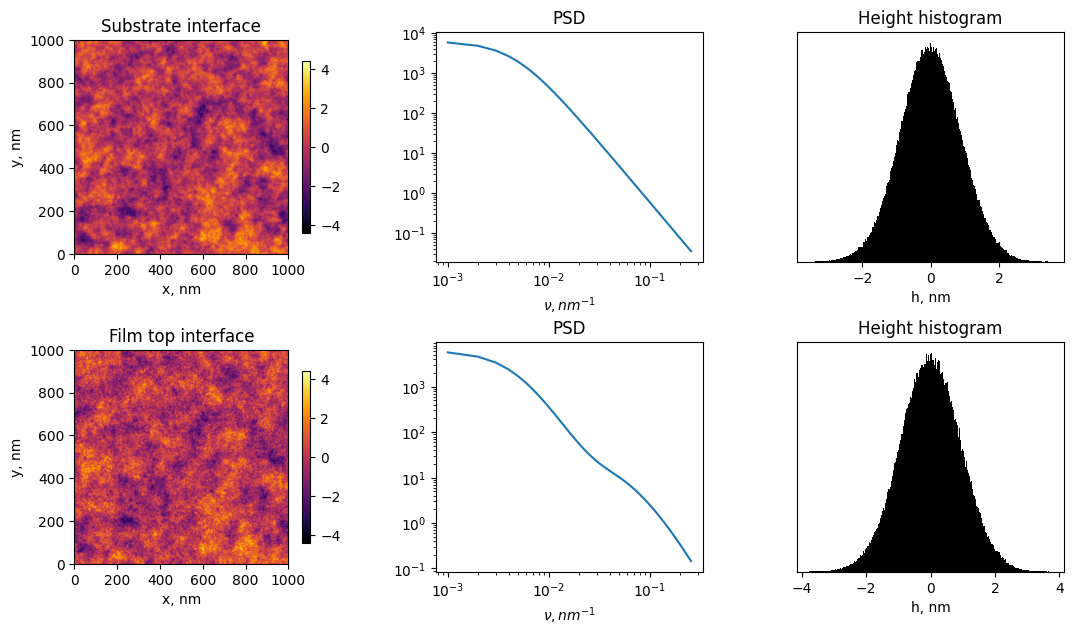
add_map(fig.add_subplot(gs[0, 0]), substrate_top,
'Substrate interface', vlim)
add_psd(fig.add_subplot(gs[0, 1]), substrate_top)
add_histogram(fig.add_subplot(gs[0, 2]), substrate_top)
add_map(fig.add_subplot(gs[1, 0]), film_top,
'Film top interface', vlim)
add_psd(fig.add_subplot(gs[1, 1]), film_top)
add_histogram(fig.add_subplot(gs[1, 2]), film_top)
def get_sample():
"""
A sample with one layer on a substrate, with partially
correlated roughnesses.
"""
# defining materials
vacuum_color = (0.90, 0.93, 0.97)
vacuum = ba.RefractiveMaterial("ambience", vacuum_color, 0, 0)
layer_color = (0.05, 0.62, 0.55)
layer_mat = ba.RefractiveMaterial("layer", layer_color, 5e-6, 0)
substrate_color = (0.28, 0.57, 0.82)
substrate_mat = ba.RefractiveMaterial("substrate", substrate_color, 15e-6, 0)
# defining roughness
height_distribution = ba.ErfTransient()
max_spat_freq = 0.5/nm
# for layer
omega = 1*nm3
a1 = 1
a2 = 10*nm
a3 = 100*nm2
a4 = 1000*nm3
autocorr_layer = ba.LinearGrowthModel(omega, a1, a2, a3, a4,
max_spat_freq)
roughness_layer = ba.Roughness(autocorr_layer, height_distribution)
# for substrate
sigma = 0.9*nm
alpha = 0.5
xi = 35*nm
autocorr_sub = ba.SelfAffineFractalModel(sigma, alpha, xi,
max_spat_freq)
roughness_sub = ba.Roughness(autocorr_sub, height_distribution)
# defining layers
l_ambience = ba.Layer(vacuum)
l_layer = ba.Layer(layer_mat, FILM_THICKNESS, roughness_layer)
l_substrate = ba.Layer(substrate_mat, roughness_sub)
# adding layers
my_sample = ba.Sample()
my_sample.addLayer(l_ambience)
my_sample.addLayer(l_layer)
my_sample.addLayer(l_substrate)
return my_sample
if __name__ == '__main__':
# sample size
Lx = 1000*nm
Ly = 1000*nm
X_points = 512
Y_points = 512
sample = get_sample()
seed = random.randrange(2**32) # random every run
# generate both rough interfaces together
maps = ba.RoughnessMap.generateInterfaceMaps(
X_points, Y_points, Lx, Ly, sample, [1, 2], seed)
film_top = maps[0]
substrate_top = maps[1]
film_low = frequency_filtered(film_top, CORRELATION_SPLIT_FREQ, True)
substrate_low = frequency_filtered(substrate_top, CORRELATION_SPLIT_FREQ,
True)
film_high = frequency_filtered(film_top, 2*CORRELATION_SPLIT_FREQ, False)
substrate_high = frequency_filtered(substrate_top,
2*CORRELATION_SPLIT_FREQ, False)
print("seed =", seed)
print("correlation model = LinearGrowthModel")
print("film thickness = {:.1f} nm".format(FILM_THICKNESS))
print("frequency split = {:.3f} nm^-1".format(CORRELATION_SPLIT_FREQ))
print("full-height correlation =",
"{:.3}".format(correlation(film_top, substrate_top)))
print("low-frequency correlation =",
"{:.3}".format(correlation(film_low, substrate_low)))
print("high-frequency correlation =",
"{:.3}".format(correlation(film_high, substrate_high)))
plot(film_top, substrate_top)
ba.showSample3D(sample, sample_size=1000*nm, seed=seed)
bp.plt.show()
|