 BornAgain
≻ git-develop
≻ Documentation ≻ Reference ≻ Sample model ≻ Structure ≻ 3D structures ≻ Disordered
BornAgain
≻ git-develop
≻ Documentation ≻ Reference ≻ Sample model ≻ Structure ≻ 3D structures ≻ Disordered
BornAgain
≻ git-develop
≻ Documentation ≻ Reference ≻ Sample model ≻ Structure ≻ 3D structures ≻ Disordered
BornAgain
≻ git-develop
≻ Documentation ≻ Reference ≻ Sample model ≻ Structure ≻ 3D structures ≻ Disordered
Class Dilute3D models random assemblies of particles
dispersed in the bulk of a layer.
It can be used for thin films as long as the film thickness is
greater than the particle diameter.
Possible applications are
To fill a layer with randomly distributed particles:
layer = ba.Layer(matrix_material, thickness)
layer.fill3D(ba.Dilute3D(density, particle))
If the layer contains an incoherent mixture of the disordered
assembly and something else, use add3D with a coverage
parameter:
layer = ba.Layer(matrix_material, thickness)
disordered = ba.Dilute3D(density, particle)
layer.add3D(coverage, disordered)
Parameters:
density: Volume number density in nm⁻³ (particles per
cubic nanometer)particle: The particle to distribute throughout the layercoverage (second form only): surface coverage, between 0
and 13D assemblies require material averaging to be enabled (the default). The layer thickness must be finite and larger than the particle size.
Spherical nanoparticles dispersed in a substrate layer:
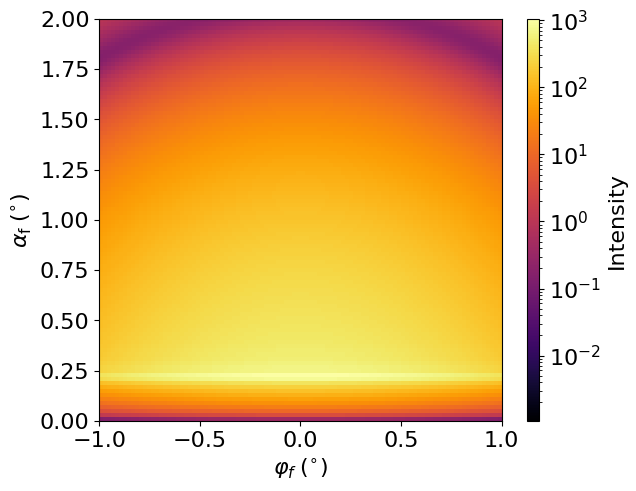
Scattering from dilute film
Comparison between a 3D film (fill3D) and a 2D monolayer
(deposit2D). As film thickness increases, the scattering
pattern evolves from the monolayer limit:
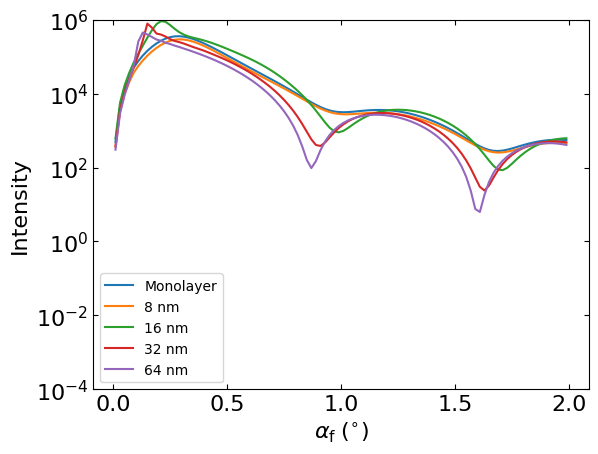
Film thickness dependence