Buried interfaces, for instance between a solid and a liquid, can be studied by sending the beam through the solid. In neutron reflectometry and GISANS, the beam typically enters a silicon or sapphire block through one of its side faces and is reflected at the interface between the solid and the liquid, at the opposite face of the block. Examples are studies of micelles under shear (Hamilton et al. 1994), of the crystallization of micelles (Wolff et al. 2004), and of colloids below an interface (Nouhi et al. 2017).
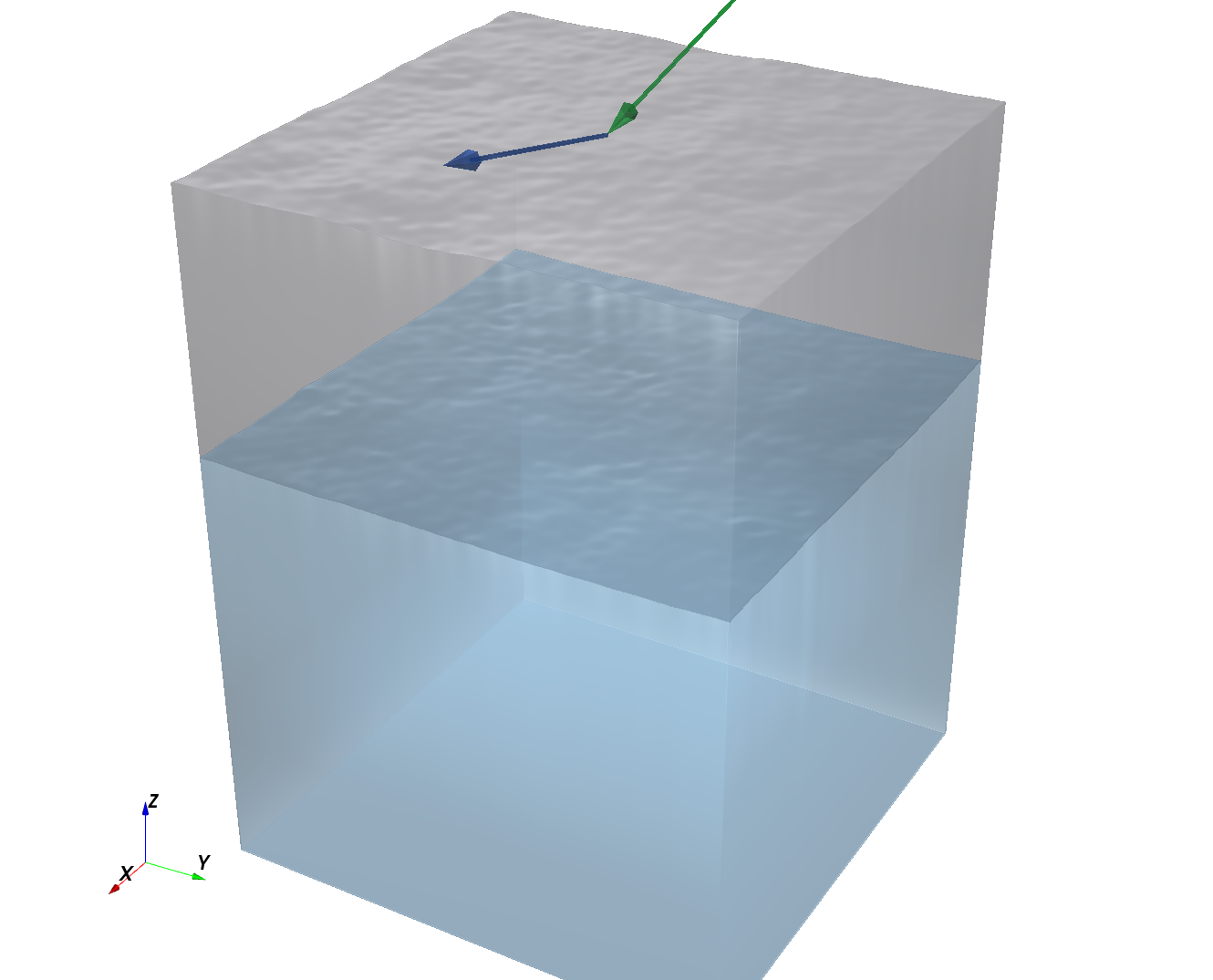
In BornAgain, the sample is described with the liquid on top and the solid block as substrate. A negative grazing angle denotes a beam that comes from below, through the substrate. As for a beam from above, the angle is the actual glancing angle in the medium of incidence, here the sapphire. The refraction at the side face of the block, where the beam enters, is not modeled: the side face is assumed to be perpendicular to the beam, or its effect to be accounted for by the user.
This example compares a bare sapphire/D₂O interface with one carrying a 30 nm thick titanium film. Since the scattering-length density of D₂O exceeds that of sapphire, the beam is totally reflected below the critical angle of about 0.16°. Above the critical angle, the Ti film produces pronounced interference fringes: its scattering-length density is negative, far below that of either neighbor, whereas the bare interface reflects only weakly because sapphire and D₂O have similar scattering-length densities.
Notes:
QzScan does not support beams from below; use AlphaScan or LambdaScan.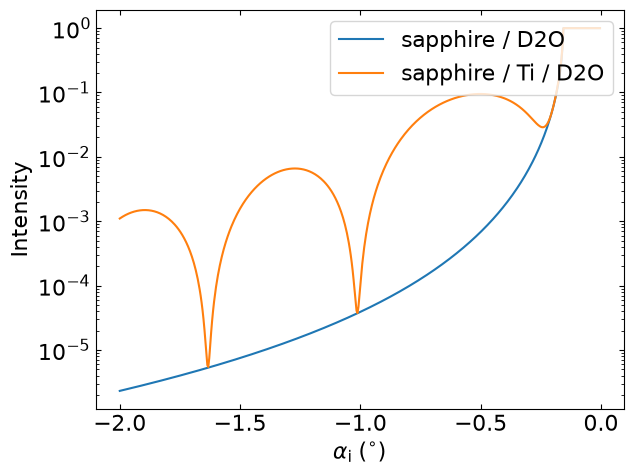
|
|
