1
  2
  3
  4
  5
  6
  7
  8
  9
 10
 11
 12
 13
 14
 15
 16
 17
 18
 19
 20
 21
 22
 23
 24
 25
 26
 27
 28
 29
 30
 31
 32
 33
 34
 35
 36
 37
 38
 39
 40
 41
 42
 43
 44
 45
 46
 47
 48
 49
 50
 51
 52
 53
 54
 55
 56
 57
 58
 59
 60
 61
 62
 63
 64
 65
 66
 67
 68
 69
 70
 71
 72
 73
 74
 75
 76
 77
 78
 79
 80
 81
 82
 83
 84
 85
 86
 87
 88
 89
 90
 91
 92
 93
 94
 95
 96
 97
 98
 99
100
101
102
103
104
105
106
107
108
109
110
111
112
113
114
115
116
117
118
119
120
121
122
123
124
125
126
127
128
129
130
131
132
133
134
135
136
137
138
139
140
141
142
143
144
145
146
147
148
149
150
151
152
153
154
155
156
157
158
159
160
161
162
163
164
165
166
167
168
169
170
171
172
173
174
175
176
177
178
179
180
181
182
183
184
185
186
187
188
189
190
191
192
193
194
195
196
197
198
199
200
201
202
203
204
205
206
207
208
209
210
211
212
213
214
215
216
217
218
219
220
221
222
223
224
225
226
227
228
229
|
#!/usr/bin/env python3
# /// script
# requires-python = ">=3.10"
# dependencies = ["bornagain>=25,<26"]
# ///
"""
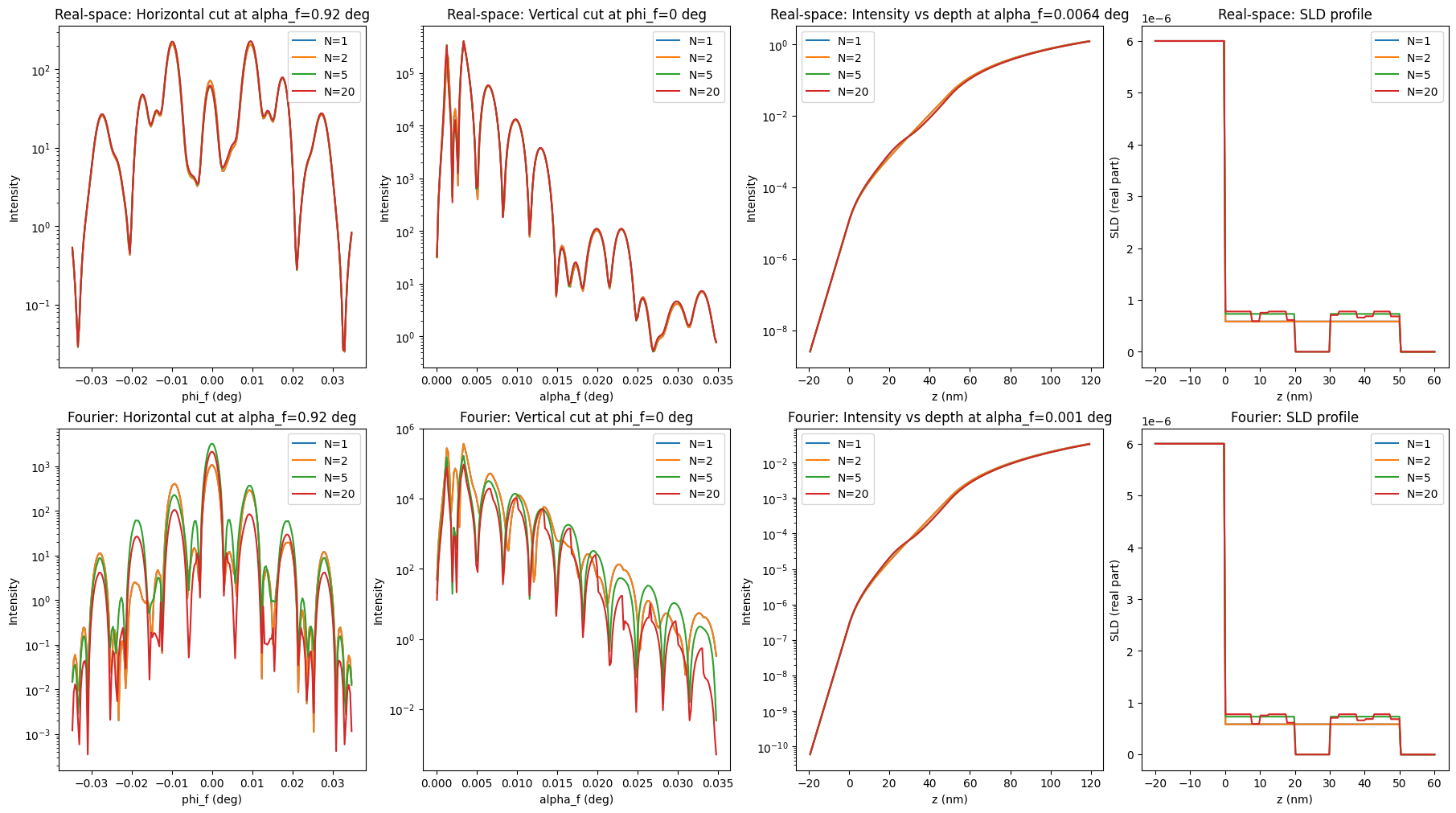
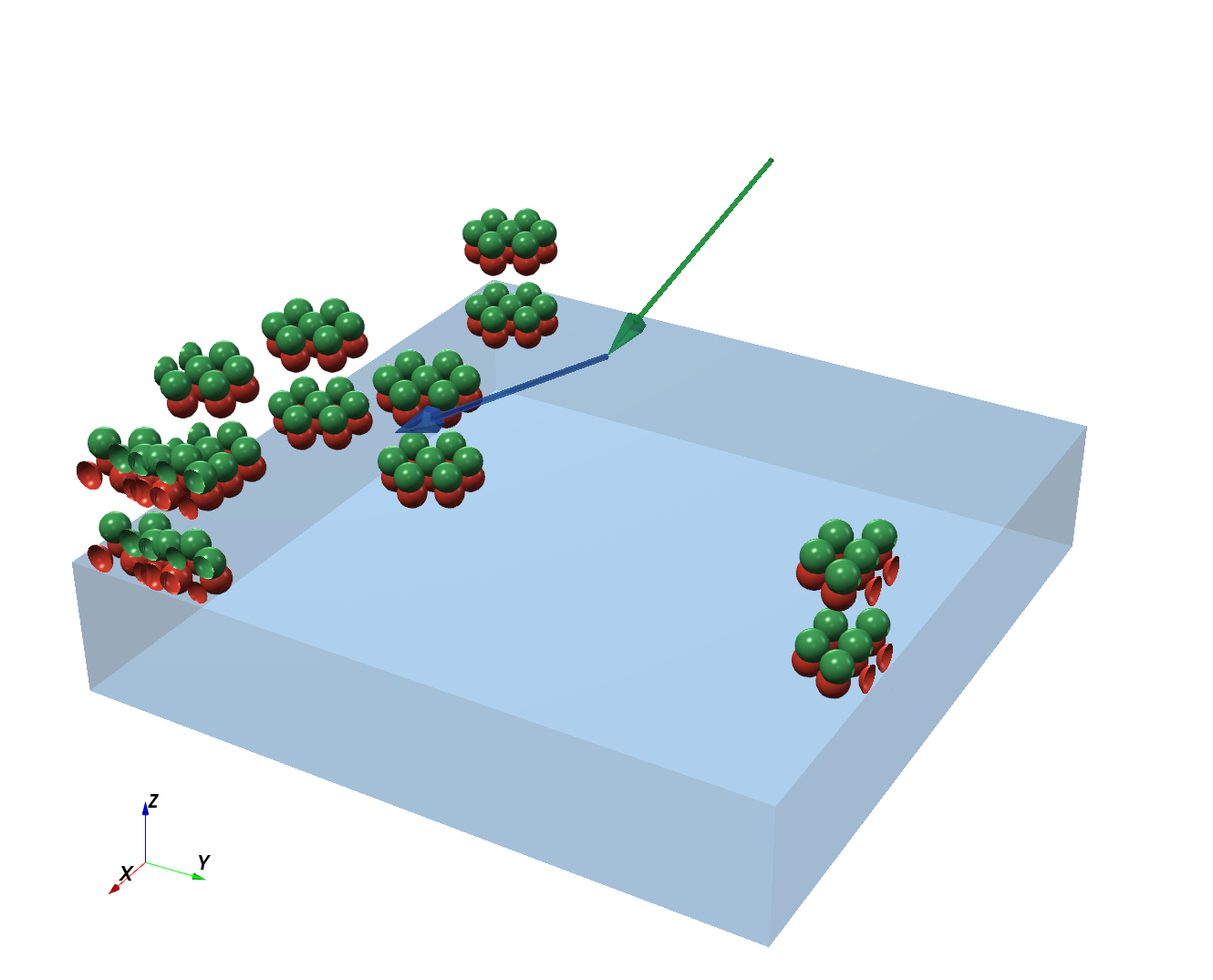
Cylindrical mesocrystal with hexagonal lattice and two-material basis.
Test to investigate intensity changes with different numbers of slices.
"""
import math
import numpy as np
import bornagain as ba
ba.require_versions("bornagain>=25,<26")
from bornagain import deg, nm, nm2, R3


def get_sample(n_slices=1):
    # Materials (zero absorption)
    particle1_color = (0.86, 0.24, 0.18)
    particle1_mat = ba.RefractiveMaterial("Particle1", particle1_color, 4e-05, 0)
    particle2_color = (0.25, 0.65, 0.35)
    particle2_mat = ba.RefractiveMaterial("Particle2", particle2_color, 8e-06, 0)
    substrate_color = (0.28, 0.57, 0.82)
    substrate_mat = ba.RefractiveMaterial("Substrate", substrate_color, 6e-06, 0)
    vacuum = ba.Vacuum()

    # Basis particles
    inner_ff = ba.FuzzySphere(4.7*nm, .4*nm)

    inner_particle1 = ba.Particle(particle1_mat, inner_ff)
    inner_particle2 = ba.Particle(particle2_mat, inner_ff)

    # 3D lattice
    lattice_a = 6.21
    lattice_c = 6.57
    sigma_a = 1.16
    position_variance = sigma_a/math.sqrt(3)

    lattice = ba.HexagonalLattice(lattice_a*2, lattice_c*2*2.3)

    bas_a = lattice.basisVectorA()
    bas_b = lattice.basisVectorB()
    bas_c = lattice.basisVectorC()

    # Basis composition
    position_0 = R3(0, 0, 0)
    position_1 = 1.0/3*(2*bas_a + bas_b + bas_c)
    basis = ba.Compound()
    basis.addComponent(inner_particle1, position_0)
    basis.addComponent(inner_particle2, position_1)

    # Crystal
    crystal = ba.Crystal(basis, lattice, position_variance)

    # Mesocrystal: shaped crystal
    outer_ff = ba.Cylinder(20*nm, 50*nm)
    outer_particle = ba.Mesocrystal(crystal, outer_ff)

    # Layers
    layer_1 = ba.Layer(vacuum)
    layer_1.deposit2D(ba.Dilute2D(0.0001/nm2, outer_particle))
    if n_slices > 1:
        layer_1.setNumberOfSlices(n_slices)
    layer_2 = ba.Layer(substrate_mat)

    # Sample
    sample = ba.Sample()
    sample.addLayer(layer_1)
    sample.addLayer(layer_2)

    return sample


def simulate_horizontal_cut(n_slices=1, reciprocal=False):
    """
    Simulate with Nx1 detector for horizontal cut at alpha_f=0.92 deg.
    """
    sample = get_sample(n_slices)
    beam = ba.Beam(1e9, 0.1*nm, 0.2*deg)
    n = 200
    # Single bin centered at alpha_f=0.92 deg
    detector = ba.SphericalDetector(n, -2*deg, 2*deg, 1, 0.91*deg, 0.93*deg)
    simulation = ba.ScatteringSimulation(beam, sample, detector)
    if reciprocal:
        simulation.options().setMesoReciprocalSum(True, 2.5)
    return simulation.simulate()


def simulate_vertical_cut(n_slices=1, reciprocal=False):
    """
    Simulate with 1xN detector for vertical cut at phi_f=0 deg.
    """
    sample = get_sample(n_slices)
    beam = ba.Beam(1e9, 0.1*nm, 0.2*deg)
    n = 200
    # Single bin centered at phi_f=0 deg
    detector = ba.SphericalDetector(1, -0.01*deg, 0.01*deg, n, 0, 2*deg)
    simulation = ba.ScatteringSimulation(beam, sample, detector)
    if reciprocal:
        simulation.options().setMesoReciprocalSum(True, 2.5)
    return simulation.simulate()


def simulate_depthprobe(n_slices=1, reciprocal=False):
    """
    Simulate intensity vs depth.
    """
    sample = get_sample(n_slices)
    n = 100
    alpha_f = 0.001*deg if reciprocal else 0.0064*deg
    scan = ba.AlphaScan([alpha_f])
    scan.setWavelength(0.1*nm)
    z_axis = ba.EquiDivision("z (nm)", n, -20*nm, 120*nm)
    simulation = ba.DepthprobeSimulation(scan, sample, z_axis)
    if reciprocal:
        simulation.options().setMesoReciprocalSum(True, 2.5)
    return simulation.simulate(), alpha_f/deg


def get_sld_profile(n_slices=1):
    """
    Returns the SLD profile of the resampled sample.
    """
    sample = get_sample(n_slices)
    n = 200
    z_min, z_max = -20*nm, 60*nm
    z = np.asarray(ba.generateZValues(n, z_min, z_max))
    sld = ba.materialProfileSLD(sample, n, z_min, z_max)
    sld_real = np.real(sld)
    return z, sld_real


# Color cycle for different N values
colors = ['C0', 'C1', 'C2', 'C3']


if __name__ == '__main__':
    # Slice counts to compare
    slice_counts = [1, 2, 5, 20]

    # Create figure with 2 rows, 4 columns
    fig, axes = ba.plt.subplots(
        2, 4, figsize=(18, 10), layout="constrained")

    # Row 1: Real-space summation (default)
    ax = axes[0, 0]
    for i, n in enumerate(slice_counts):
        result = simulate_horizontal_cut(n_slices=n, reciprocal=False)
        ax.semilogy(result.xCenters(), result.flatVector(),
                    label=f'N={n}', color=colors[i])
    ax.set_title('Real-space: Horizontal cut at alpha_f=0.92 deg')
    ax.set_xlabel('phi_f (deg)')
    ax.set_ylabel('Intensity')
    ax.legend()

    ax = axes[0, 1]
    for i, n in enumerate(slice_counts):
        result = simulate_vertical_cut(n_slices=n, reciprocal=False)
        ax.semilogy(result.yCenters(), result.flatVector(),
                    label=f'N={n}', color=colors[i])
    ax.set_title('Real-space: Vertical cut at phi_f=0 deg')
    ax.set_xlabel('alpha_f (deg)')
    ax.set_ylabel('Intensity')
    ax.legend()

    ax = axes[0, 2]
    for i, n in enumerate(slice_counts):
        result, alpha_f = simulate_depthprobe(n_slices=n, reciprocal=False)
        ax.semilogy(result.yCenters(), result.flatVector(),
                    label=f'N={n}', color=colors[i])
    ax.set_title(f'Real-space: Intensity vs depth at alpha_f={alpha_f:.4f} deg')
    ax.set_xlabel('z (nm)')
    ax.set_ylabel('Intensity')
    ax.legend()

    ax = axes[0, 3]
    profiles = []
    for n in slice_counts:
        z, sld = get_sld_profile(n_slices=n)
        profiles.append((f'N={n}', z, sld))
    ba.plot_material_profile(
        profiles, z_unit=nm, ax=ax,
        xlabel='z (nm)', ylabel='SLD (real part)')
    ax.set_title('Real-space: SLD profile')
    ax.legend()

    # Row 2: Reciprocal-space (Fourier) summation
    ax = axes[1, 0]
    for i, n in enumerate(slice_counts):
        result = simulate_horizontal_cut(n_slices=n, reciprocal=True)
        ax.semilogy(result.xCenters(), result.flatVector(),
                    label=f'N={n}', color=colors[i])
    ax.set_title('Fourier: Horizontal cut at alpha_f=0.92 deg')
    ax.set_xlabel('phi_f (deg)')
    ax.set_ylabel('Intensity')
    ax.legend()

    ax = axes[1, 1]
    for i, n in enumerate(slice_counts):
        result = simulate_vertical_cut(n_slices=n, reciprocal=True)
        ax.semilogy(result.yCenters(), result.flatVector(),
                    label=f'N={n}', color=colors[i])
    ax.set_title('Fourier: Vertical cut at phi_f=0 deg')
    ax.set_xlabel('alpha_f (deg)')
    ax.set_ylabel('Intensity')
    ax.legend()

    ax = axes[1, 2]
    for i, n in enumerate(slice_counts):
        result, alpha_f = simulate_depthprobe(n_slices=n, reciprocal=True)
        ax.semilogy(result.yCenters(), result.flatVector(),
                    label=f'N={n}', color=colors[i])
    ax.set_title(f'Fourier: Intensity vs depth at alpha_f={alpha_f:.3f} deg')
    ax.set_xlabel('z (nm)')
    ax.set_ylabel('Intensity')
    ax.legend()

    ax = axes[1, 3]
    profiles = []
    for n in slice_counts:
        z, sld = get_sld_profile(n_slices=n)
        profiles.append((f'N={n}', z, sld))
    ba.plot_material_profile(
        profiles, z_unit=nm, ax=ax,
        xlabel='z (nm)', ylabel='SLD (real part)')
    ax.set_title('Fourier: SLD profile')
    ax.legend()
    ba.showSample3D(get_sample(), sample_size=250*nm, seed=189)
    ba.plt.show()
|
 BornAgain
≻ git-develop
≻ Documentation ≻ Examples ≻ GISAS ≻ Structures and correlations ≻ Mesocrystal with basis slices
BornAgain
≻ git-develop
≻ Documentation ≻ Examples ≻ GISAS ≻ Structures and correlations ≻ Mesocrystal with basis slices