1
  2
  3
  4
  5
  6
  7
  8
  9
 10
 11
 12
 13
 14
 15
 16
 17
 18
 19
 20
 21
 22
 23
 24
 25
 26
 27
 28
 29
 30
 31
 32
 33
 34
 35
 36
 37
 38
 39
 40
 41
 42
 43
 44
 45
 46
 47
 48
 49
 50
 51
 52
 53
 54
 55
 56
 57
 58
 59
 60
 61
 62
 63
 64
 65
 66
 67
 68
 69
 70
 71
 72
 73
 74
 75
 76
 77
 78
 79
 80
 81
 82
 83
 84
 85
 86
 87
 88
 89
 90
 91
 92
 93
 94
 95
 96
 97
 98
 99
100
101
102
103
104
105
106
107
108
109
110
111
112
113
114
115
116
117
118
119
120
121
122
123
124
125
126
|
#!/usr/bin/env python3
# /// script
# requires-python = ">=3.10"
# dependencies = ["bornagain>=25,<26"]
# ///
"""
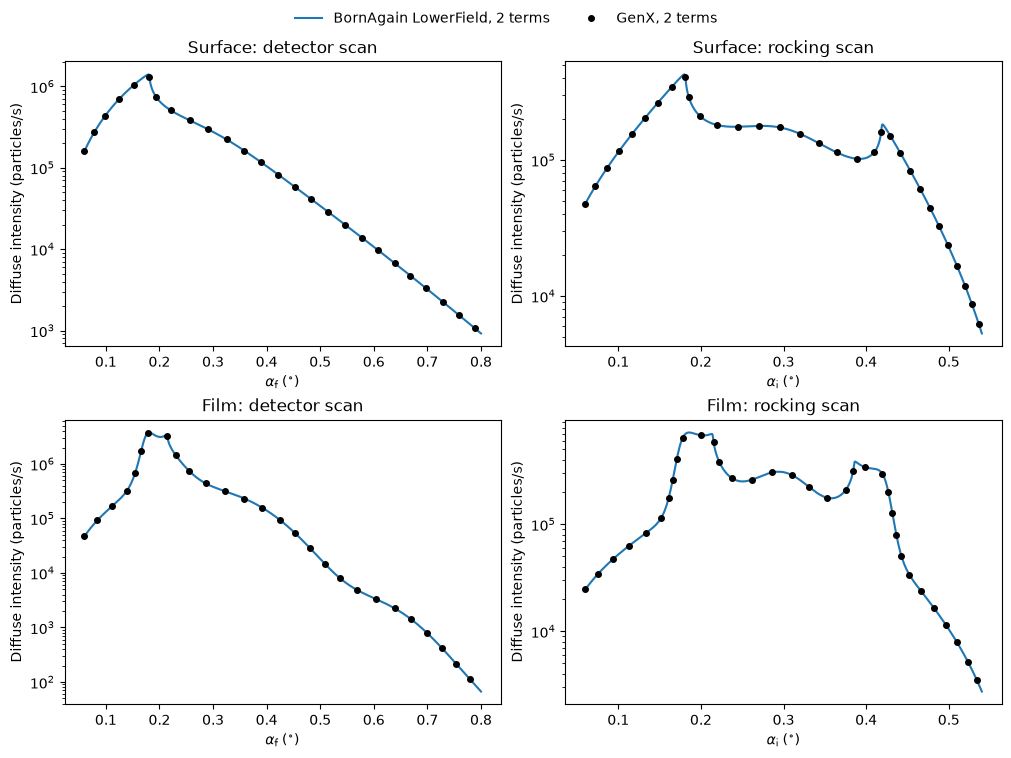
Diffuse detector and rocking scans compared with reference data from GenX.

Both programs use sharp reference waves and the lower-field continuation
(LowerField) with two terms. Place the four GenX data files next to this
script.
"""
from pathlib import Path
import numpy as np
import bornagain as ba
ba.require_versions("bornagain>=25,<26")
from bornagain import deg, nm

ALPHA_I = 0.25*deg  # incident angle of the detector scans
TWO_THETA = 0.6*deg  # scattering angle of the rocking scans
DATA_FILES = {
    ('surface', 'detector'): "genx_roughness_surface_detector.dat.gz",
    ('surface', 'rocking'): "genx_roughness_surface_rocking.dat.gz",
    ('film', 'detector'): "genx_roughness_film_detector.dat.gz",
    ('film', 'rocking'): "genx_roughness_film_rocking.dat.gz",
}


def get_sample(kind, hurst=0.5):
    """
    A rough surface, or a film on a substrate with correlated roughness.
    """
    film_color = (0.4, 0.7, 0.9)
    substrate_color = (0.3, 0.5, 0.7)
    sample = ba.Sample()
    sample.addLayer(ba.Layer(ba.Vacuum()))
    if kind == 'film':
        film = ba.RefractiveMaterial('Film', film_color, 3e-6, 1e-8)
        model = ba.PoweredExponentialModel(2*nm, hurst, 1000*nm)
        roughness = ba.Roughness(model, ba.ErfTransient(),
                                 ba.CommonDepthCrosscorrelation(40*nm))
        sample.addLayer(ba.Layer(film, 20*nm, roughness))
        substrate = ba.RefractiveMaterial('Substrate', substrate_color,
                                          7e-6, 3e-8)
        rms = 3*nm
    else:
        substrate = ba.RefractiveMaterial('Substrate', substrate_color,
                                          5e-6, 2e-8)
        rms = 2*nm
    model = ba.PoweredExponentialModel(rms, hurst, 1000*nm)
    roughness = ba.Roughness(model, ba.ErfTransient(),
                             ba.CommonDepthCrosscorrelation(40*nm))
    sample.addLayer(ba.Layer(substrate, roughness))
    return sample


def get_simulation(sample, alpha_i, alpha_f):
    """
    For each incident angle alpha_i[j], a detector slit at alpha_f[j].
    """
    scan = ba.AlphaScan(alpha_i)
    scan.setWavelength(0.1*nm)
    scan.setIntensity(1e8)
    detector = ba.SlitOffspecDetector(alpha_f, 0.1*deg, -1*deg, 1*deg)
    simulation = ba.OffspecSimulation(scan, sample, detector)
    simulation.options().setIncludeSpecular(False)
    simulation.options().setDwbaReferenceWaves('Sharp')
    simulation.options().setRoughnessApproximation('LowerField', 2)
    return simulation


def simulate(sample, geometry, reference):
    """
    Return the diffuse intensity at the angles of the reference scan.
    """
    angles = np.array(reference.xCenters())
    if geometry == 'detector':
        values = [
            get_simulation(sample, [ALPHA_I], [alpha]).simulate().valAt(0)
            for alpha in angles
        ]
    else:
        simulation = get_simulation(sample, angles, TWO_THETA - angles)
        values = simulation.simulate().flatVector()
    return ba.Datafield(reference.frame(), values)


def load_reference(kind, geometry):
    """
    Return the GenX intensity in particles/s against the scanned angle.
    """
    path = Path(__file__).resolve().parent/DATA_FILES[kind, geometry]
    angles, intensity = np.loadtxt(path, unpack=True)
    label = 'alpha_f (rad)' if geometry == 'detector' else 'alpha_i (rad)'
    frame = ba.Frame(ba.ListScan(label, (angles*deg).tolist()))
    return ba.Datafield(frame, intensity.tolist())


if __name__ == '__main__':
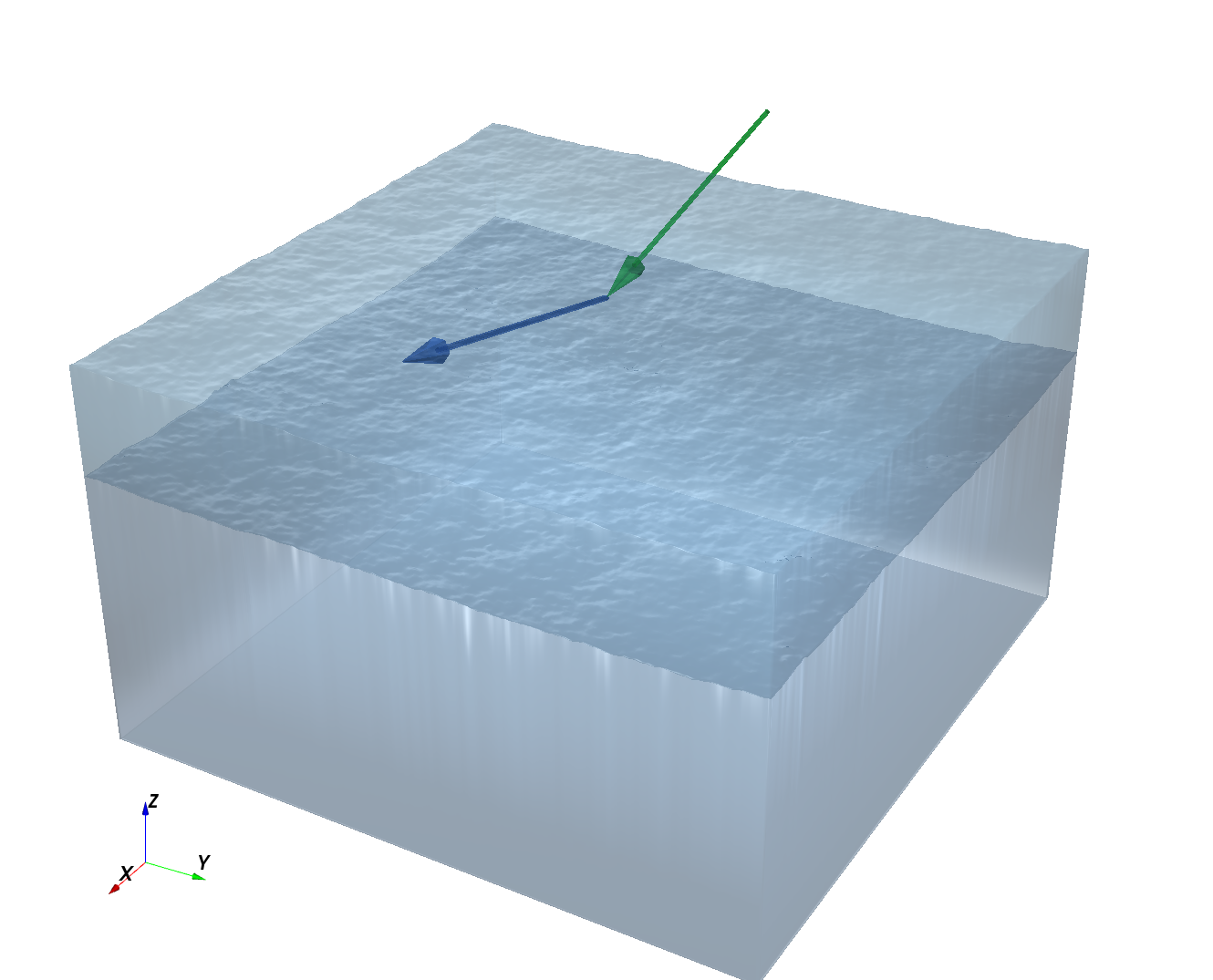
    ba.showSample3D(get_sample('film'), sample_size=120*nm, seed=0)
    fig = ba.plt.figure(figsize=(10, 7.5), layout='constrained')
    axes = fig.subplots(2, 2)
    for axis, (kind, geometry) in zip(axes.flat, DATA_FILES):
        reference = load_reference(kind, geometry)
        result = simulate(get_sample(kind), geometry, reference)
        ba.plot_multicurve([None],
                           measured=[reference],
                           labels=['GenX, 2 terms'],
                           ax=axis,
                           pointargs={
                               'fmt': 'o',
                               'color': 'black',
                               'markersize': 4,
                               'markevery': 0.04
                           })
        ba.plot_multicurve([result],
                           labels=['BornAgain LowerField, 2 terms'],
                           ax=axis,
                           ylabel='Diffuse intensity (particles/s)')
        axis.set_title(f'{kind.capitalize()}: {geometry} scan')
    fig.legend(*axes.flat[0].get_legend_handles_labels(),
               loc='outside upper center',
               ncol=2,
               frameon=False)

    ba.plt.show()
|