1
  2
  3
  4
  5
  6
  7
  8
  9
 10
 11
 12
 13
 14
 15
 16
 17
 18
 19
 20
 21
 22
 23
 24
 25
 26
 27
 28
 29
 30
 31
 32
 33
 34
 35
 36
 37
 38
 39
 40
 41
 42
 43
 44
 45
 46
 47
 48
 49
 50
 51
 52
 53
 54
 55
 56
 57
 58
 59
 60
 61
 62
 63
 64
 65
 66
 67
 68
 69
 70
 71
 72
 73
 74
 75
 76
 77
 78
 79
 80
 81
 82
 83
 84
 85
 86
 87
 88
 89
 90
 91
 92
 93
 94
 95
 96
 97
 98
 99
100
101
102
103
104
105
106
107
108
109
110
111
112
113
|
#!/usr/bin/env python3
# /// script
# requires-python = ">=3.10"
# dependencies = ["bornagain>=25,<26", "lmfit"]
# ///
"""
Basic example how to fit specular data.
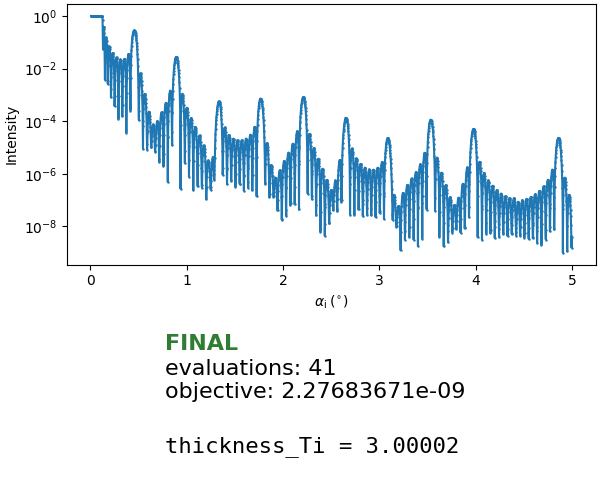
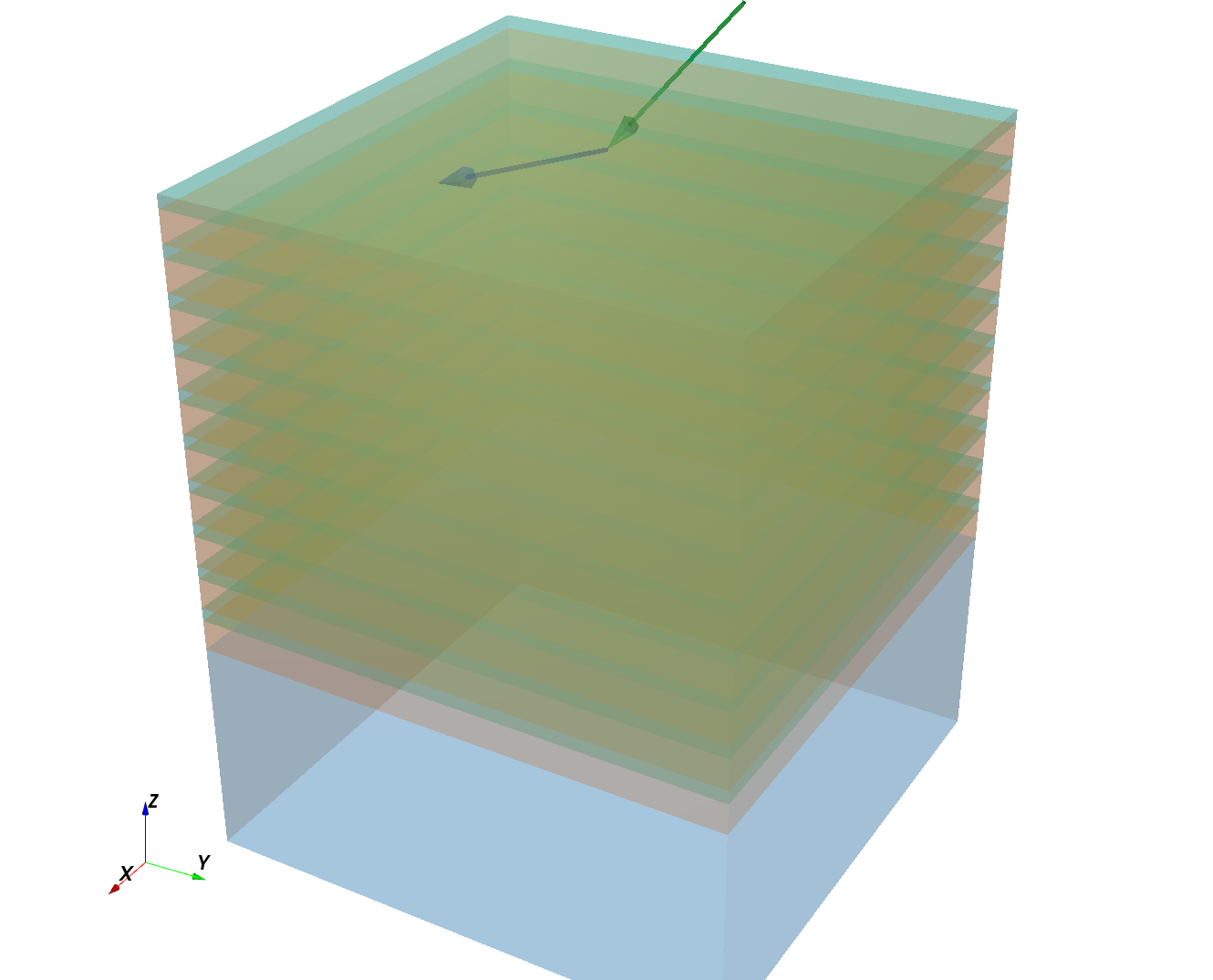
The sample consists of twenty alternating Ti and Ni layers.
Reference data was generated with GenX.
We fit just one parameter, the thickness of the Ti layers,
which has an original value of 30 angstroms.
"""

import bornagain as ba
ba.require_versions("bornagain>=25,<26")
from pathlib import Path
from bornagain import angstrom, nm
import lmfit
import numpy as np


def load_data(filename):
    # Data files are next to this script.
    data_dir = Path(__file__).resolve().parent
    fname = data_dir / filename

    two_alpha, intensity = ba.read_columns(fname, usecols=(0, 1))
    alpha = 0.5*two_alpha*ba.deg
    return alpha, intensity


def datafield_from_arrays(x, y):
    frame = ba.Frame(ba.ListScan("alpha_i (rad)", x))
    return ba.Datafield(frame, y.tolist())


def get_sample(P):
    # Materials
    ti_color = (0.05, 0.62, 0.55)
    ti_mat = ba.SLDMaterial("Ti", ti_color, -1.9493e-06, 0)
    ni_color = (0.93, 0.48, 0.14)
    ni_mat = ba.SLDMaterial("Ni", ni_color, 9.4245e-06, 0)
    si_color = (0.30, 0.62, 0.86)
    si_mat = ba.SLDMaterial("Si", si_color, 2.0704e-06, 0)

    # Layers
    layer_Ti = ba.Layer(ti_mat, P["thickness_Ti"])
    layer_Ni = ba.Layer(ni_mat, 70*angstrom)

    # Periodic stack
    n_repetitions = 10
    stack = ba.LayerStack(n_repetitions)
    stack.addLayer(layer_Ti)
    stack.addLayer(layer_Ni)

    # Sample
    sample = ba.Sample()
    sample.addLayer(ba.Layer(ba.Vacuum()))
    sample.addStack(stack)
    sample.addLayer(ba.Layer(si_mat))

    return sample


def get_simulation(alpha_axis, P):
    scan = ba.AlphaScan(alpha_axis)
    scan.setWavelength(1.54*angstrom)
    sample = get_sample(P)

    return ba.SpecularSimulation(scan, sample)


if __name__ == '__main__':
    alpha, exp_values = load_data("genx_alternating_layers.dat.gz")
    exp_data = datafield_from_arrays(alpha, exp_values)

    # Fit progress display
    fit_plotter = ba.FitPlotter(
        ba.plot_curve,
        measured=exp_data,
        ylabel="Intensity",
    )

    monitor = ba.FitMonitor(
        fit_plotter,
        ncols=1,
        show_best=True,
        max_fps=1,
        printer=ba.Printer(every_nth=10),
        live=True)

    def residuals(P):
        """
        Simulates, reports, and returns the residual vector.
        """
        sim_result = get_simulation(alpha, P.valuesdict()).simulate()
        residuals = exp_values - sim_result.intensities()
        monitor.update(sim_result, P, residuals)
        return residuals

    P = lmfit.Parameters()
    P.add("thickness_Ti", value=5*nm, min=1*nm, max=6*nm)

    result = lmfit.minimize(residuals, P, method="leastsq")

    finalP = result.params.valuesdict()
    # Recompute and report the simulation at the fitted parameters.
    residuals(result.params)
    # Render the just-reported evaluation as the final fit state.
    monitor.render_final(result.params)
    print(lmfit.fit_report(result))
    ba.showSample3D(get_sample(finalP), sample_size=120*nm, seed=0)
    ba.plt.show()
|