1
 2
 3
 4
 5
 6
 7
 8
 9
10
11
12
13
14
15
16
17
18
19
20
21
22
23
24
25
26
27
28
29
30
31
32
33
34
35
36
37
38
39
40
41
42
43
44
45
46
47
48
49
50
51
52
53
54
55
56
57
58
59
60
|
#!/usr/bin/env python3
# /// script
# requires-python = ">=3.10"
# dependencies = ["bornagain>=25,<26"]
# ///
"""
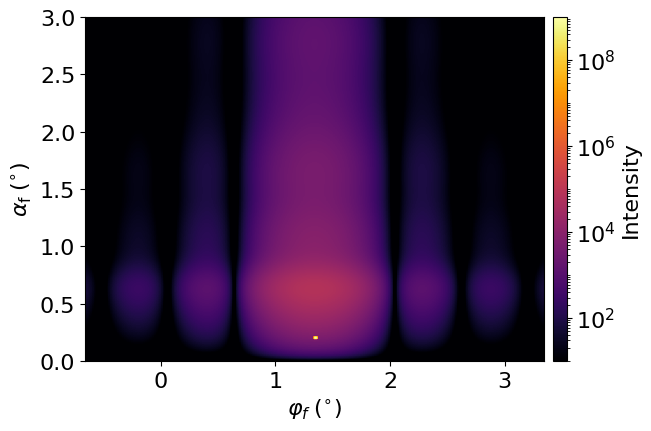
Same as CylindersAndSpecular.py, but with a beam azimuth of 1.34 deg.

The azimuthal range of the detector is centred at the beam azimuth, so that
the detector covers the specular peak.
"""
import bornagain as ba
ba.require_versions("bornagain>=25,<26")
from bornagain import deg, nm

phi = 1.34*deg


def get_sample():
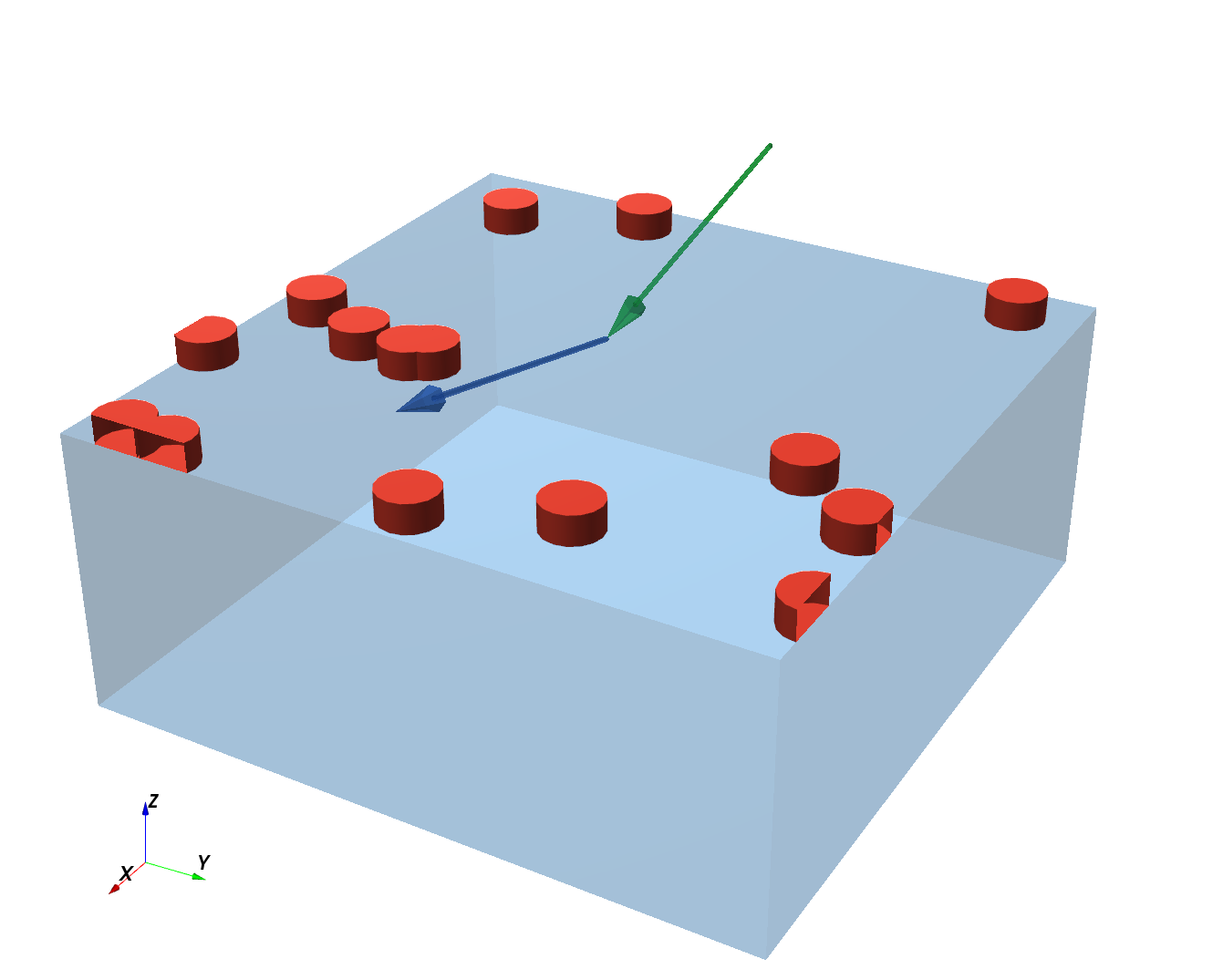
    """
    A dilute random assembly of cylinders on a substrate.
    """
    substrate_color = (0.28, 0.57, 0.82)
    substrate_mat = ba.RefractiveMaterial("Substrate", substrate_color, 6e-6, 2e-8)
    particle_color = (0.86, 0.24, 0.18)
    particle_mat = ba.RefractiveMaterial("Particle", particle_color, 6e-4, 2e-8)
    particle = ba.Particle(particle_mat, ba.Cylinder(5*nm, 5*nm))

    particle_layer = ba.Layer(ba.Vacuum())
    particle_layer.deposit2D(ba.Dilute2D(0.001, particle))
    substrate_layer = ba.Layer(substrate_mat)

    sample = ba.Sample()
    sample.addLayer(particle_layer)
    sample.addLayer(substrate_layer)
    return sample


def get_simulation(sample):
    # Beam with non-zero phi
    wavelength = 0.1*nm
    alpha_i = 0.2*deg
    beam = ba.Beam(1e9, wavelength, alpha_i, phi)

    # Azimuthal range centred at the beam azimuth, to include the specular peak
    n = 200
    detector = ba.SphericalDetector(n, -2*deg + phi, 2*deg + phi, n, 0., 3*deg)

    simulation = ba.ScatteringSimulation(beam, sample, detector)
    simulation.options().setIncludeSpecular(True)
    return simulation


if __name__ == '__main__':
    sample = get_sample()
    ba.showSample3D(sample, sample_size=120*nm, seed=0)
    simulation = get_simulation(sample)
    result = simulation.simulate()
    ba.plot_datafield(result, unit_aspect=1, log_range=8)
    ba.plt.show()
|
 BornAgain
≻ git-develop
≻ Documentation ≻ Examples ≻ GISAS ≻ Simulation setup and instrument ≻ Oblique device