1
 2
 3
 4
 5
 6
 7
 8
 9
10
11
12
13
14
15
16
17
18
19
20
21
22
23
24
25
26
27
28
29
30
31
32
33
34
35
36
37
38
39
40
41
42
43
44
45
46
47
48
49
50
51
52
53
54
55
56
57
58
59
60
|
#!/usr/bin/env python3
# /// script
# requires-python = ">=3.10"
# dependencies = ["bornagain>=25,<26"]
# ///
"""
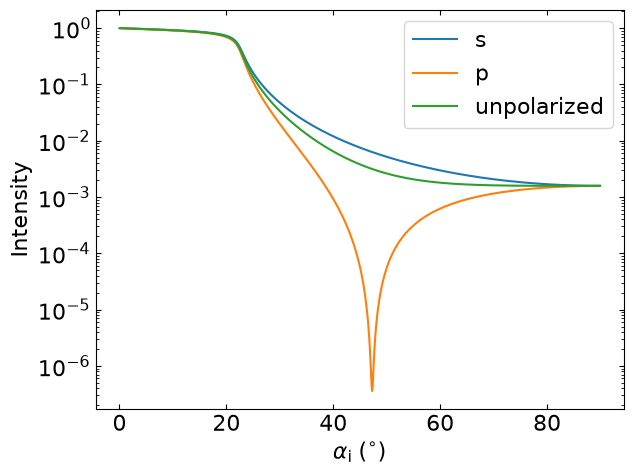
Reflectivity of a molybdenum surface for extreme ultraviolet light (13.5 nm),
for s- and p-polarized and for unpolarized beams, from grazing to near-normal
incidence.

The s waves have their electric field perpendicular to the plane of
incidence, the p waves in it. At grazing incidence, both are almost totally
reflected. At the Brewster angle, here 47 deg, the reflectivity of p waves has
a deep minimum, which would be zero without absorption. An unpolarized beam is
reflected with the mean of both. For hard x-rays, the Brewster angle is also
near 45 deg, but there the reflectivity is negligible, about 1e-9 for Mo at
8 keV.
"""
import bornagain as ba
ba.require_versions("bornagain>=25,<26")
from bornagain import deg, nm


def get_sample():
    vacuum = ba.Vacuum()
    molybdenum_color = (0.55, 0.55, 0.6)
    # Optical constants of molybdenum at 13.5 nm, from the Henke tables
    molybdenum = ba.RefractiveMaterial("Mo", molybdenum_color, 0.0762, 0.00644)

    sample = ba.Sample()
    sample.addLayer(ba.Layer(vacuum))
    sample.addLayer(ba.Layer(molybdenum))
    return sample


def simulate(sample, angle, degree, title):
    """
    Reflectivity for linear polarization at the given angle from s toward p
    (0 for s, 90 deg for p), with the given degree of polarization (0 for an
    unpolarized beam).
    """
    n = 1000
    scan = ba.AlphaScan(n, 0.05*deg, 89.9*deg)
    scan.setWavelength(13.5*nm)
    scan.setXrayPolarization(angle=angle, axis_ratio=0, degree=degree)
    simulation = ba.SpecularSimulation(scan, sample)
    result = simulation.simulate()
    result.setTitle(title)
    return result


if __name__ == '__main__':
    sample = get_sample()
    results = [
        simulate(sample, 0, 1, "s"),
        simulate(sample, 90*deg, 1, "p"),
        simulate(sample, 0, 0, "unpolarized"),
    ]
    ba.plot_multicurve(results)
    ba.plt.show()
|
 BornAgain
≻ git-develop
≻ Documentation ≻ Examples ≻ Specular ≻ Instrument and resolution ≻ X-ray polarization