1
  2
  3
  4
  5
  6
  7
  8
  9
 10
 11
 12
 13
 14
 15
 16
 17
 18
 19
 20
 21
 22
 23
 24
 25
 26
 27
 28
 29
 30
 31
 32
 33
 34
 35
 36
 37
 38
 39
 40
 41
 42
 43
 44
 45
 46
 47
 48
 49
 50
 51
 52
 53
 54
 55
 56
 57
 58
 59
 60
 61
 62
 63
 64
 65
 66
 67
 68
 69
 70
 71
 72
 73
 74
 75
 76
 77
 78
 79
 80
 81
 82
 83
 84
 85
 86
 87
 88
 89
 90
 91
 92
 93
 94
 95
 96
 97
 98
 99
100
101
102
103
104
105
106
107
108
109
110
111
112
113
114
|
#!/usr/bin/env python3
# /// script
# requires-python = ">=3.10"
# dependencies = ["bornagain>=25,<26", "scipy>=1.7"]
# ///
"""
SciPy differential evolution for BornAgain fits.
"""
import bornagain as ba
ba.require_versions("bornagain>=25,<26")
from bornagain import deg, nm
import numpy as np
import scipy.optimize


def get_sample(P):
    """
    Spheres on a hexagonal lattice, parameterized for fitting.
    """
    substrate_color = (0.28, 0.57, 0.82)
    substrate_mat = ba.RefractiveMaterial("Substrate", substrate_color, 6e-6, 2e-8)

    particle_color = (0.86, 0.24, 0.18)
    particle_mat = ba.RefractiveMaterial("Particle", particle_color, 6e-4, 2e-8)

    particle = ba.Particle(particle_mat, ba.Sphere(P["radius"]))

    lattice = ba.HexagonalLattice2D(P["length"], 0)
    struct = ba.Crystal2D(particle, lattice)
    struct.setDecayFunction(ba.Profile2DCauchy(100*nm, 100*nm, 0))

    particle_layer = ba.Layer(ba.Vacuum())
    particle_layer.deposit2D(struct)

    sample = ba.Sample()
    sample.addLayer(particle_layer)
    sample.addLayer(ba.Layer(substrate_mat))
    return sample


def get_simulation(P):
    """
    GISAS simulation for the parameterized hexagonal lattice.
    """
    n_pix = 100

    beam = ba.Beam(1e8, 0.1*nm, 0.2*deg)
    detector = ba.SphericalDetector(n_pix, -1*deg, 1*deg, n_pix, 0, 2*deg)

    simulation = ba.ScatteringSimulation(beam, get_sample(P), detector)
    return simulation


def fake_data():
    """
    Noisy synthetic data for a known hexagonal lattice.
    """
    P = {"radius": 5*nm, "length": 14*nm}
    return get_simulation(P).simulate().noisy(0.1, 0.1)


def print_result(result, initial_objective):
    """
    Prints selected fields of the SciPy OptimizeResult.
    """
    radius, length = result.x
    print(f"Success: {result.success}")
    print(f"Message: {result.message}")
    print(f"Initial objective: {initial_objective:.6g}")
    print(f"Objective: {result.fun:.6g}")
    print(f"Function evaluations: {result.nfev}")
    print(f"radius: {radius:.6g}")
    print(f"length: {length:.6g}")


if __name__ == '__main__':
    # Generate synthetic data for the fit target.
    data = fake_data()
    flat_exp_values = data.intensities().ravel()

    def scalar_objective(values):
        """
        Runs a simulation and returns the sum of squared residuals.
        """
        radius, length = values
        parameters = {"radius": radius, "length": length}
        simulation = get_simulation(parameters)
        result = simulation.simulate()
        flat_sim_values = result.intensities().ravel()
        residuals = flat_sim_values - flat_exp_values
        return np.sum(residuals*residuals)

    # Define SciPy's initial candidate and bounds.
    initial_values = np.array([4.5*nm, 13.5*nm])
    bounds = [(4*nm, 6*nm), (13*nm, 15*nm)]
    initial_objective = scalar_objective(initial_values)

    # differential_evolution expects a scalar objective value.
    result = scipy.optimize.differential_evolution(
        scalar_objective,
        bounds=bounds,
        x0=initial_values,
        maxiter=30,
        popsize=6,
        polish=True,
        seed=0)

    print_result(result, initial_objective)
    radius, length = result.x
    final_parameters = {"radius": radius, "length": length}
    final_result = get_simulation(final_parameters).simulate()
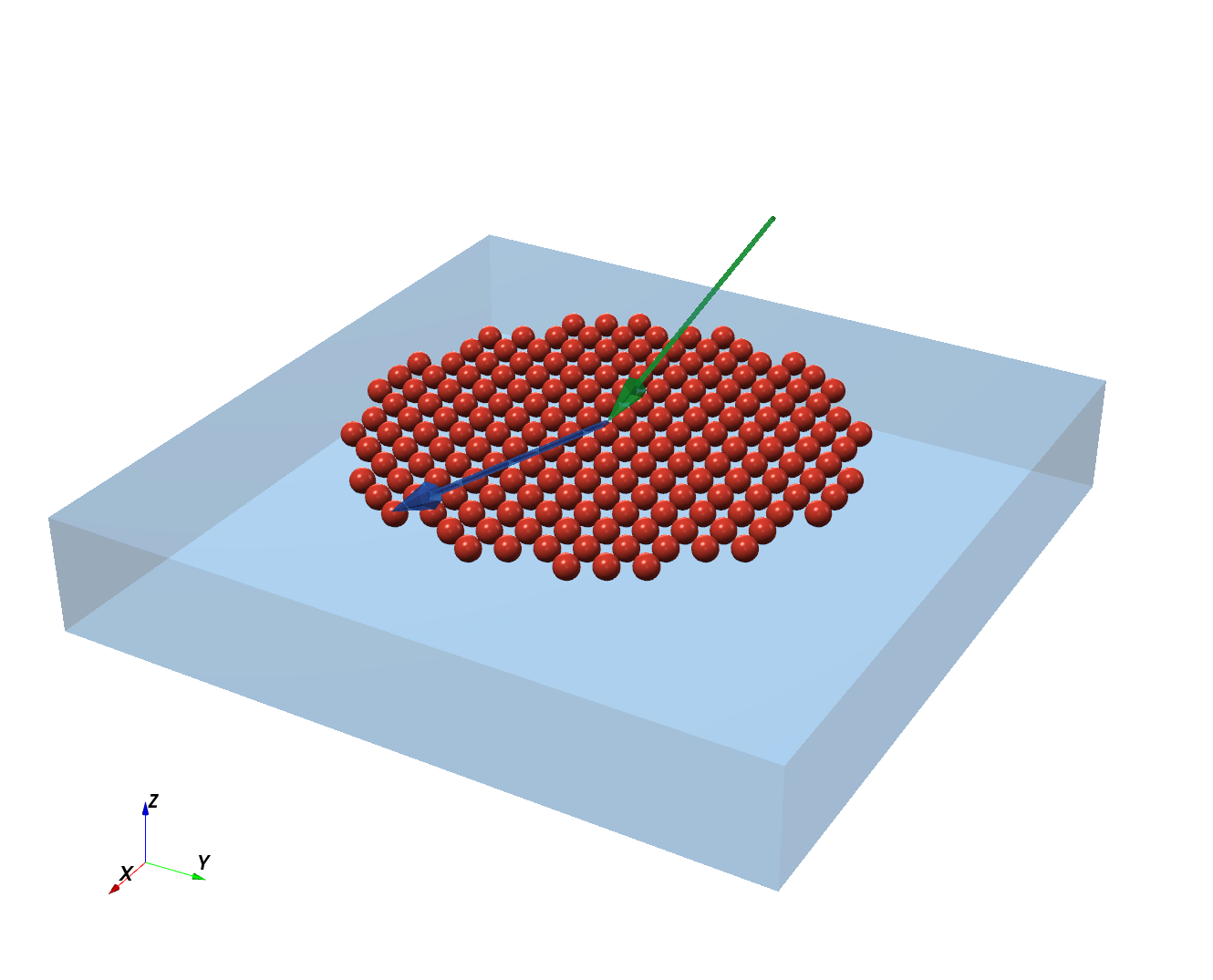
    ba.showSample3D(get_sample(final_parameters), sample_size=300*nm, seed=0)
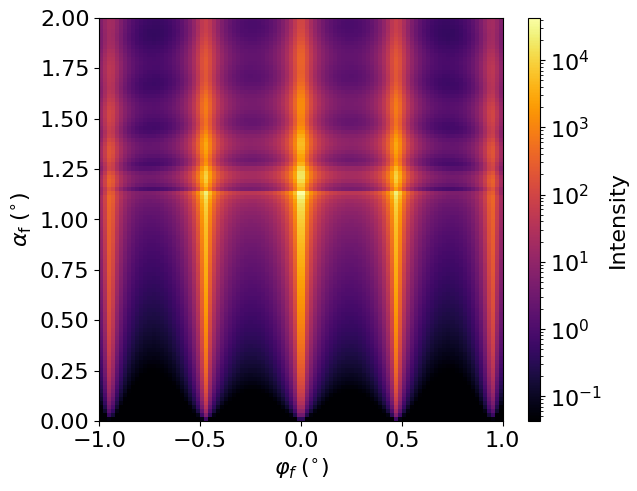
    ba.plot_datafield(final_result, unit_aspect=1)
    ba.plt.show()
|