Zeeman splitting in an applied field

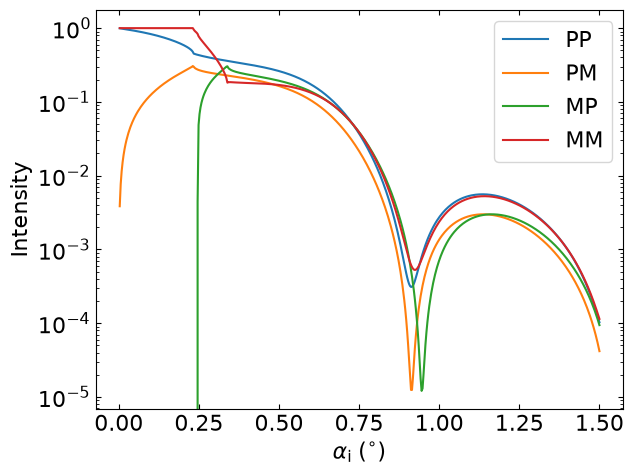
Polarized reflectivity of an Fe film on Si, magnetized along x, in a field of 0.5 T applied along y. The applied field is set through sample.setExternalField, in A/m; it is the field in the top layer, and adds to the magnetization of every layer.

In the top layer, the field splits the kinetic energies of the two spin states. A spin-flipped neutron therefore leaves at a different angle than it entered, and its reflectivity carries the ratio of the outgoing to the incident vertical wavenumber. Below a cutoff angle, the spin-flipped wave of one channel (here MP) cannot propagate in the top layer, and that channel is closed, while the other (PM) is enhanced. See specular simulation for the conventions, and magnetization for the field setting.
Result

Zeeman splitting result

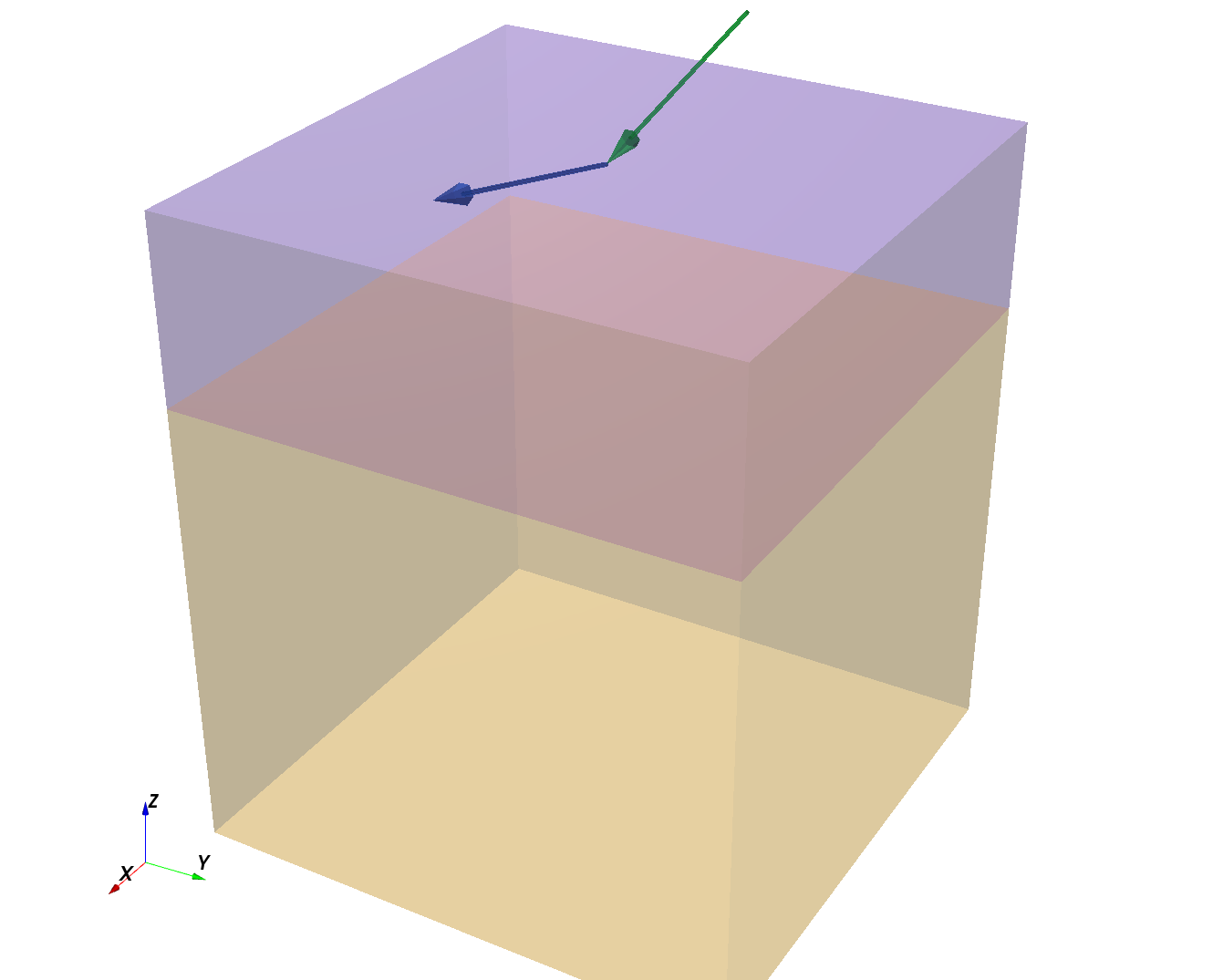
Sample

Zeeman splitting sample

Python script

 1
 2
 3
 4
 5
 6
 7
 8
 9
10
11
12
13
14
15
16
17
18
19
20
21
22
23
24
25
26
27
28
29
30
31
32
33
34
35
36
37
38
39
40
41
42
43
44
45
46
47
48
49
50
51
52
53
54
55
56
57
58
#!/usr/bin/env python3
# /// script
# requires-python = ">=3.10"
# dependencies = ["bornagain>=25,<26"]
# ///
"""
Polarized neutron reflectometry in a strong applied magnetic field.

An Fe film on Si, magnetized along x, in a field of 0.5 T applied along y
(the field is set in A/m through sample.setExternalField). The field
permeates the top layer, where it splits the kinetic energies of
the two spin states (Zeeman effect): a spin-flipped neutron leaves at an
angle different from the incident one, and below a cutoff angle one of
the spin-flip channels (MP) is closed, while the other (PM) is enhanced.
Polarizer and analyzer must be parallel or antiparallel to the field.
"""
import bornagain as ba
ba.require_versions("bornagain>=25,<26")
from bornagain import angstrom, deg, nm, R3


def get_sample():
    vacuum = ba.Vacuum()
    fe_color = (0.48, 0.32, 0.80)
    fe_mat = ba.SLDMaterial("Fe", fe_color, 8.02e-6, 0, R3(1.7e6, 0, 0))
    si_color = (0.93, 0.72, 0.25)
    si_mat = ba.SLDMaterial("Si", si_color, 2.07e-6, 0)

    sample = ba.Sample()
    sample.addLayer(ba.Layer(vacuum))
    sample.addLayer(ba.Layer(fe_mat, 20*nm))
    sample.addLayer(ba.Layer(si_mat))
    sample.setExternalField(R3(0, 0.5*ba.tesla, 0))  # mu_0 H = 0.5 T along y
    return sample


def simulate(sample, pol, an, title):
    n = 500
    scan = ba.AlphaScan(n, 1.5*deg/n, 1.5*deg)
    scan.setWavelength(5*angstrom)
    scan.setPolarization(pol)
    scan.setAnalyzer(an)
    result = ba.SpecularSimulation(scan, sample).simulate()
    result.setTitle(title)
    return result


if __name__ == '__main__':
    sample = get_sample()
    ba.showSample3D(sample, sample_size=60*nm, seed=0)
    results = [
        simulate(sample, R3(0, +1, 0), R3(0, +1, 0), "PP"),
        simulate(sample, R3(0, +1, 0), R3(0, -1, 0), "PM"),
        simulate(sample, R3(0, -1, 0), R3(0, +1, 0), "MP"),
        simulate(sample, R3(0, -1, 0), R3(0, -1, 0), "MM"),
    ]
    ba.plot_multicurve(results)
    ba.plt.show()
auto/Examples/specular/magnetic/ZeemanSplitting.py