Class Disordered3D models random assemblies of uncorrelated particles
in the bulk.
It can be used for thin films as long as the film thickness is substantially
greater than the particle diameter.
Possible applications are
nanoparticle-filled polymer films,
colloidal suspensions, and
any other system where particles (or holes) are dispersed in a matrix.
Creating a 3D assembly
To fill a layer with randomly distributed particles,
use the function Layer.plugLiquid:
If the layer contains an incoherent mixture of the disordered assembly
and something else, then a Disordered3D object must be explicitly created,
and added to the layer with a Layer.addStruct function call:
density: Volume number density in nm⁻³ (particles per cubic nanometer)
particle: The particle to distribute throughout the layer
approximation_flag (optional): see below, Correlation models
weight (second form only): incoherent weight, between 0 and 1
Correlation models
For dilute systems, particles scatter independently. For denser systems,
spatial correlations between particles affect the scattering. Two models
are available:
# Dilute approximation (default): no correlationslayer.plugLiquid(density,particle,ba.Random3D_Dilute)# Percus-Yevick hard-sphere model: accounts for excluded volumelayer.plugLiquid(density,particle,ba.Random3D_PY)
The Percus-Yevick approximation models hard-sphere correlations and becomes
important when the particle volume fraction is significant.
Requirements
3D assemblies require material averaging to be enabled (the default).
The layer thickness must be finite and larger than the particle size.
Examples
Dilute film
Spherical nanoparticles dispersed in a substrate layer:
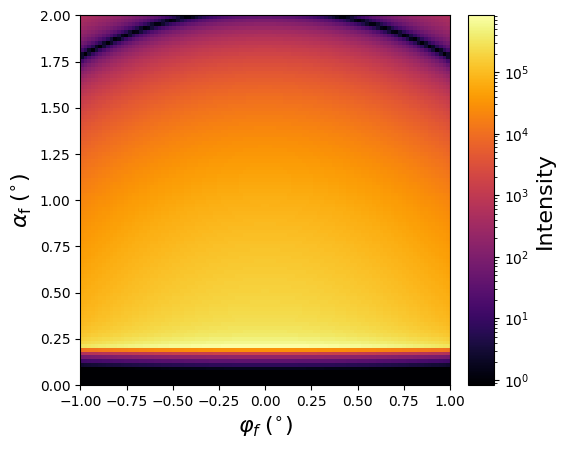
#!/usr/bin/env python3"""
Dilute film of small spheres
"""importbornagainasbafrombornagainimportba_plotasbp,deg,nm,nm3defget_sample():# Materialsmaterial_particle=ba.RefractiveMaterial("Particle",0.0006,2e-08)material_substrate=ba.RefractiveMaterial("Substrate",6e-06,2e-08)vacuum=ba.Vacuum()# Particlesff=ba.Sphere(2*nm)particle=ba.Particle(material_particle,ff)# Layerslayer_1=ba.Layer(vacuum)layer_2=ba.Layer(material_substrate,30*nm)layer_3=ba.Layer(material_substrate)layer_2.plugLiquid(.0005/nm3,particle)# Samplesample=ba.Sample()sample.addLayer(layer_1)sample.addLayer(layer_2)sample.addLayer(layer_3)returnsampledefget_simulation(sample):beam=ba.Beam(1e9,0.1*nm,0.2*deg)n=100detector=ba.SphericalDetector(n,-1*deg,1*deg,n,0.,2*deg)simulation=ba.ScatteringSimulation(beam,sample,detector)returnsimulationif__name__=='__main__':sample=get_sample()simulation=get_simulation(sample)result=simulation.simulate()bp.plot_datafield(result)bp.plt.show()
auto/Examples/scatter2d/DiluteFilm.py
Dense film: dilute vs Percus-Yevick
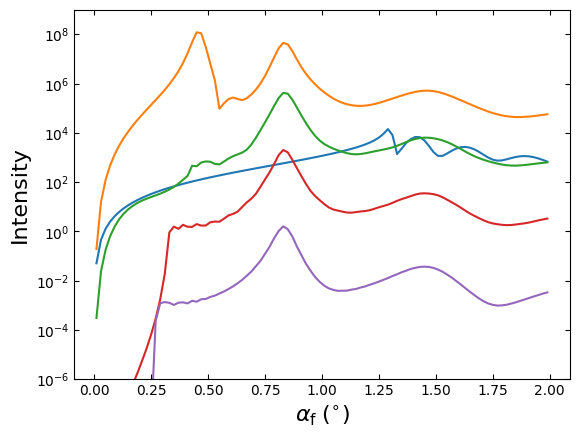
Comparison of dilute approximation and Percus-Yevick model for a denser
film. The PY model shows structure factor oscillations due to hard-sphere
correlations:
#!/usr/bin/env python3"""
Dilute film of small spheres
"""importbornagainasbafrombornagainimportba_plotasbp,deg,nm,nm3defget_sample(approximation):# Materialsmaterial_particle=ba.RefractiveMaterial("Particle",0.0006,2e-08)material_substrate=ba.RefractiveMaterial("Substrate",6e-06,2e-08)vacuum=ba.Vacuum()# Particlesff=ba.Sphere(4*nm)particle=ba.Particle(material_particle,ff)# Layerslayer_1=ba.Layer(vacuum)layer_2=ba.Layer(material_substrate,30*nm)layer_3=ba.Layer(material_substrate)layer_2.plugLiquid(.002/nm3,particle,approximation)# Samplesample=ba.Sample()sample.addLayer(layer_1)sample.addLayer(layer_2)sample.addLayer(layer_3)returnsampledefget_simulation(sample):beam=ba.Beam(1e9,0.1*nm,0.2*deg)n=100# Just compute a 1d cut at phi=0detector=ba.SphericalDetector(1,-1*deg,1*deg,n,0.,2*deg)simulation=ba.ScatteringSimulation(beam,sample,detector)returnsimulationif__name__=='__main__':samples=[get_sample(ba.Random3D_Dilute),get_sample(ba.Random3D_PY)]results=[get_simulation(sample).simulate()forsampleinsamples]forrinresults:bp.plot_datafield(r)bp.plt.legend(['Dilute','Percus-Yevick'])bp.plt.show()
auto/Examples/scatter2d/DenseFilm.py
Film vs monolayer
Comparison between a 3D film (plugLiquid) and a 2D monolayer
(depositParticle). As film thickness increases, the scattering pattern
evolves from the monolayer limit: